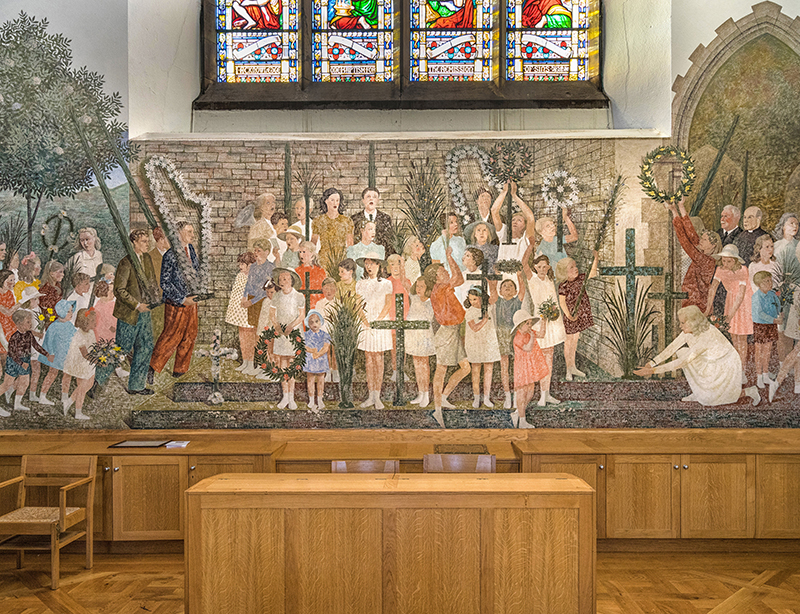
The first time a visitor enters St. Mary’s Church in Ambleside, the first thing she notices is the beautiful and intriguing mural on the back wall. Everything about it is unusual, including its history. Gordon Ransom was a student at London’s Royal College of Art, but during World War II he and his classmates were evacuated to Ambleside. In 1944, in the final year of his studies, he spent four months creating the mural that depicts an annual church festival that is characteristic of only a handful of communities in northern England.
📷: Photo North (www.photonorth.co.uk)
The festival is rush-bearing and Ransom’s mural is shown here. What exactly is rush-bearing? Mary Armitt describes it as “a Church Festival that has come down from ancient times, and which, after a period of languishment, has revived once more into a popular pageant.”[1] Apparently when churches had earthen floors, rushes were gathered by the community and placed on the ground to provide a natural carpet for parishioners. The green rushes also brought a pungent and aromatic fragrance to the sacred space. Over the years, even as earthen floors gave way to floors of wood and stone, the act of bearing of rushes continued.
Why does the festival continue even though churches have finished floors? The Rev. Francis Lewis insisted that “above all, … it is your children’s festival.” Its purpose is “to make your church the centre of your children’s lives, to imprint deeply upon their young minds the importance of the things of the spirit.” Festivals for the children’s sake continue an ancient tradition, according to A. W. Morton:
The law required a father to explain great festivals to his son… The child was always at the heart of each [festival]. This is the genius of the Jewish people. They placed the child at the center of life.[2]
On the Ninth Sunday after Trinity, July 29, 1923, Lewis preached a Sermon in Grasmere Church. The Rushbearing Festival was only a few days away. It was a fitting time for him to proclaim that “so much depends upon our children,” a proclamation that we need to hear again today.
By the Rev. F. Lewis. The Parents’ Review, 1923, pp. 598-603
Ps. 149. 6. 7.—Let the high praises of God be in their mouth, and a two-edged sword in their hand; To execute vengeance upon the heathen and punishments upon the people.
Zechariah IV. 6. pt.—This is the word of the Lord unto Zerubbabel, saying, not by might, nor by power, but by My Spirit, saith the Lord of hosts.
Some scholars have thought that the 149th Psalm belongs to the time of the Maccabees. That was a period when the Jews were fighting for their lives and their national existence against the tyranny of the Kings of Syria, especially of Antiochus Epiphanes. One of the objects of that tyranny had been to force a Hellenic civilization upon Palestine. The Hebrew scriptures had been sought out for destruction, and the altar of the Temple at Jerusalem had been desecrated by the sacrifice of a swine upon it. Every effort had been made to destroy by force the national spirit of the Jews. But no force can quell the stubborn hearts of men. The national spirit only burned the more fiercely and, in spite of disastrous defeats, carried the Jews to eventual success.
This Psalm, then, is supposed by some to have been composed for the feast of the Dedication of the Temple when the services were restored and reparation was made for the desecration of the holy place. But though there is much in the Psalm which fits in with such circumstances, yet there are other points which make against it. There are more points in favour of an earlier date for the Psalm. We are carried back to the days of Nehemiah. That period again is a period of restoration. You know how distressed Nehemiah was at the Persian Court at Susa, when his kinsman brought word to him of the deplorable condition of Jerusalem and Palestine. “The remnant that are left of the captivity there in the province are in great affliction and reproach: the wall of Jerusalem also is broken down, and the gates thereof are burned with fire.”
We can get some idea, too, from the book of Nehemiah and the books of the prophets Haggai, Zechariah, and Malachi, of the social conditions of the time, of the extreme poverty of the labouring classes, and of their oppression by the rich. It was a time when there was a call for social regeneration and that was the task which was set before Nehemiah. He had to rebuild the walls of Jerusalem and to restore a right spirit in his fellow-countrymen. His difficulties were two-fold. There was opposition from foes without; there were selfish interests to be fought against within the city. They had to build the walls with the trowel in their hand and the sword girded to their side, and the trumpeter stationed to give warning where and when the attack was to be made, that they might drop the trowel and take the sword and hasten to repel the assault.
Most suitable then to the circumstances are the words of the Psalm, “Let the high praises of God be in their mouth, and a two-edged sword in their hand; to execute vengeance upon the heathen and punishments upon the people.” But there is a discord in the words of triumph; “vengeance,” “punishment,” both are suggestive of force. Force will never secure a lasting peace. Force raises the spirit of resistance and rebellion. Force cannot quell the stubborn hearts of men.
We are reaping the fruits now of the wrong conceptions by which the terms of peace were dictated, in the political, social, and industrial unrest which is rampant to-day. Vengeance and punishment were made much too prominent in the moment of victory. It was said at the time of the war that we were fighting for justice, truth and righteousness, but in all the negotiations during the last five wearisome years has any regard been paid to any one of the three things? What spirit of conciliation has been shown by any one of the parties or nations concerned? It has been a miserable haggling in a spirit of fear of one or other losing or conceding a material advantage. Only one thought has dominated all the proceedings—an unspiritual thought—what material advantage shall we gain, how will it benefit our trade? It is a motive wholly wrong, it is one that can only be supported by force. We need an entirely new spirit in the world. The regeneration can only be brought about by the Spirit. “This is the word of the Lord unto Zerubbabel saying ‘Not by might, nor by power, but by My Spirit’, saith the Lord of hosts.”
The reproach of failure is often levelled against the Church. Those in authority are wont to tie its hands, gag its mouth and cripple its feet, and then reproach it with its ineffectual efforts towards the redemption and regeneration of the world. But the Spirit of the Lord God is within it. The gates of Hades do not prevail against it. The Spirit of the Lord is not bound. Secretly and silently He works. “Thy paths are in the great waters and Thy footsteps are not known.” “Not by might nor by power, but by My Spirit saith the Lord of hosts.”
The great temptations of our Lord were really temptations to use force. Was He to use that miraculous power of His in order to settle the always pressing problem of how to get the wherewithal to live? Was He to use the power of Roman Government and Greek civilisation to subdue men unto Himself? Was He to compel their faith by a startling manifestation of His control over the hidden forces of Nature? In the study of our Lord’s Temptations I think we may find the key to much of His teaching and His method of working. The words of the angel to Zerubbabel are the answer to the suggestions of the Tempter whether to our Lord Himself or to any of His followers, to use force in the regeneration of human life: “Not by might, nor by power, but by My Spirit, saith the Lord of hosts.”
A great lesson is surely driven home to us by the story of Elijah. It shows us the futility of force in the long run. By force Jezebel had tried to exterminate the worship of the Lord God of Israel. With force Elijah retaliated when for a moment the people came on to his side with the shout of “The Lord He is the God, the Lord He is the God.” But a startling miracle cannot produce an enduring faith. It will confirm perhaps an already existing faith. But a faith that rests on compulsion cannot endure. Faith is the response of the soul to the leading, and calling of God. It springs from within, not from without. Wind and storm, and war and tumult, it is true, fulfil the word of God. Bacon said “the earth moves violently to its place and silently in it.” The storm, the earthquake, the fire, the instruments of might, were manifestations of God’s power, but the real revelation came in the soft stilling which followed them. Then could be heard the voice of God speaking in the silent deeps of the heart. And when God reveals Himself to man He reveals man to himself. As man comes to know God better he comes to know himself better. As St. Peter realised God in Christ, he realised what he himself was. “Depart from me for I am a sinful man, O Lord.” So Elijah learned that his triumph on Carmel was a defeat. He had misunderstood the ways of God. “I have been very jealous for the Lord God of Hosts because the children of Israel have forsaken Thy covenant, thrown down Thine altars and slain Thy prophets with the sword; and I, even I only, am left; and they seek my life to take it away.” How often does this cry of despair rise up from the heart of a faithful servant of God! How often does it rise from a misunderstanding of God’s nature and God’s ways. The attack upon God seems to come from His own people. The zeal of a pastor is often a misguided zeal. He looks for results of his work, instead of doing his work as a faithful minister, bearing witness to justice and truth and righteousness, and leaving the issues with God. “The seed grows secretly, he knows not how, first the blade and then the ear and after that the full corn in the ear.” The minister can only plant and water, it is God who gives the increase. “Yet have I left me seven thousand in Israel; all the knees that have not bowed to Ball and all the lips that have not kissed him.” “The world forgetting, by the world forgot.” It is in such as they in whom the knowledge of God is kept alive, who burn with the spirit of the living God, who are unconscious of the holy influence which they shed round them. In the cottage homes of Palestine lived those seven thousand whom Elijah had overlooked, but who were the real guardians of truth and piety. It is in our country parishes to-day that we shall still look for truth and piety.
We have our problems in the country, God knows. Sin lurks in the country parishes no less than in those of the town, yet I cannot but feel that it is to the country parishes we must look for the defence of truth and honour and righteousness. The young people drift to the towns in search of work, or it may be of pleasure and excitement, but as the years go on their hearts will turn back to the old home in the country; the holy influences which they thought dead within them are still alive. It will not take much to quicken them into vigorous life. The one who went to seek his fortune in the town looks forward to the time when he shall be able to retire to spend the evening of his days in the village which gave him birth. How often will his thoughts settle upon the old parish church with all its holy associations of life and death. There was he baptised, there was he confirmed, there he knelt to take “the chalice of the grapes of God,” there he plighted his troth to the wife of his heart, there he listened to the words which spoke of hope and comfort in the hours of loneliness and grief. The village church should be the core and centre of village life. It used to be so in distant ages of our history. The church was so often the only building of any size in a village, that it was not only the place of worship, it was the common place of meeting, even at times the theatre in which they enacted their mystery plays and moralities. No distinction was drawn between the secular and the religious. There is not, there cannot be, any real distinction between them.
All things alike are hallowed by the presence of God. A thing one needs very much to remember is that God is everywhere; that every act of our daily life should be an act of worship. Worship is honour of God. We honour God when we put our best into every thing that we do, when we scorn to put out work that is slipshod or slovenly. By bad work we dishonour alike God, our neighbour, and ourselves. We should live our religion. About seventy years ago a prominent nobleman walked out of church in indignation because the clergyman in his sermon had pointed out the bearing which religion has upon daily life and conduct. “As if,” said the angry nobleman, “religion had anything to do with our daily life!” That, of course, is something of which we need a frequent reminder. We need to find God in our daily work and occupations, not merely when we say our prayers or assemble in church for public worship. In church we gather to shut out for a time, if we can, all thoughts of the world and concentrate our minds upon God, but we must take God with us back into the world. We need His presence every passing hour. Especially “we need the living Presence of Him of whom the Gospels speak, alive and close to us to-day, to Whom we can turn in the hour of need, Whose influence we can feel more potent than that of anyone on earth.”
At the end of this week you will be keeping here your Rushbearing Festival. Remember, above all, that it is your children’s festival. You wish to make your church the centre of your children’s lives, to imprint deeply upon their young minds the importance of the things of the spirit. In confirmation we try to get them to understand that they come to receive the gift of the Spirit in His sevenfold power. They receive the Spirit in order that they may bring forth the fruit of the Spirit and consecrate, each of them, their special gifts to the service of God and man.
The temptation of Zerubbabel was to use the might of the state and the power of the church to enforce the law of righteousness. It is the common temptation of every age. At the present day we are relying so much upon the State to order all things that we are losing the spirit of self-reliance which is based upon faith in God. Acts of Parliament will not make men righteous, nor will an education that is not permeated with religion,—the Christian religion. Civilisation is at the cross roads; which way will it take? The way of Christ, which is salvation? or the way of the world, life organised apart from God, the way that leads to destruction? So much depends upon our children. Let them be instructed in the Faith of Jesus Christ, be closely united with Him by personal faith, and be imbued with His spirit.
The collect for this week furnishes us with the prayer we require to meet our need; “the spirit to think and do always such things as be rightful that we may be enabled to live according to the will of God.” We live not by the greatness of our gifts, but by the Spirit of God. “Not by might, nor by power, but by My Spirit, saith the Lord of Hosts.”
Editor’s Note: The formatting of the above article was optimized for online viewing. To access a version which is formatted more similarly to the original, and which includes the original page numbers, please click here.
Endnotes for the Editor’s Note
[1] Armitt, Mary (1912). The Church of Grasmere: A History (p. 217). Kendal: Titus Wilson.
[2] Morton, A. W. (2009). The Zondervan Encyclopedia of the Bible (Revised, Full-Color Edition, Vol. 2, pp. 242–243). The Zondervan Corporation.