The CMP Review — Week of May 4
May 4, 2026

“It is the communion at a common fount of life that counts,—the mutual enjoyment of book or character, of bird or flower, of mathematical problem or scientific discovery. In such fellowship the mother, the teacher, becomes first the friend and then the philosopher and guide in life’s occasions, chiefly because she has known how to enjoy and then to wait, to wait ready with the guidance that may be needed. If it is not asked for it is given best in the literary, impersonal form by some great writer, not in the form of an oral lesson on the subject, or a ‘talk,’ nor even in that of the topic started and ‘discussion invited.’ If guidance is directly asked for, with such a mutual understanding already established, a few words will set the traveller on the right road.” (“Moral Training”, PR27, E.K.)@tessakeath
May 5, 2026

In 1917, Charlotte Mason faced many obstacles while attempting to obtain a fair hearing for her ideas. She believed that she had identified certain principles heretofore unknown or ignored that could revolutionize education. But many people were reluctant to consider her claims.
One common obstacle was the tendency to merge or subordinate Mason’s ideas into some other system of education. In 1912 The Montessori Method was first published in English, and then as now, many people were quick to claim that Mason and Montessori were simply two sides of the same coin, and that their ideas could be combined.
After Mason had written two letters to The Times, “a thoughtful letter” was published by a reader who was eager to identify similarities between Mason and Montessori. This prompted Mason’s third and final 1917 letter on the topic of “A Liberal Education for All.”
It seems that not too much has changed since 1917. In our time, many are reluctant to even consider that Mason’s ideas could be new, powerful, and enduring. Surely, so many assert, they are merely variations on someone else’s ideas, whether Plato or Montessori.
To readers in 1917 as well as in 2026 the best response is probably Mason’s own words. Her third letter is as relevant and compelling today as it was a century ago. Read or hear it here.
@artmiddlekauff
May 6, 2026

Evening Primrose
When once the sun sinks in the west,
And dewdrops pearl the evening’s breast;
Almost as pale as moonbeams are,
Or its companionable star,
The evening primrose opes anew
Its delicate blossoms to the dew;
And, hermit-like, shunning the light,
Wastes its fair bloom upon the night,
Who, blindfold to its fond caresses,
Knows not the beauty it possesses;
Thus it blooms on while night is by;
When day looks out with open eye,
Bashed at the gaze it cannot shun,
It faints and withers and is gone.
— John Clare
@rbaburina
May 7, 2026
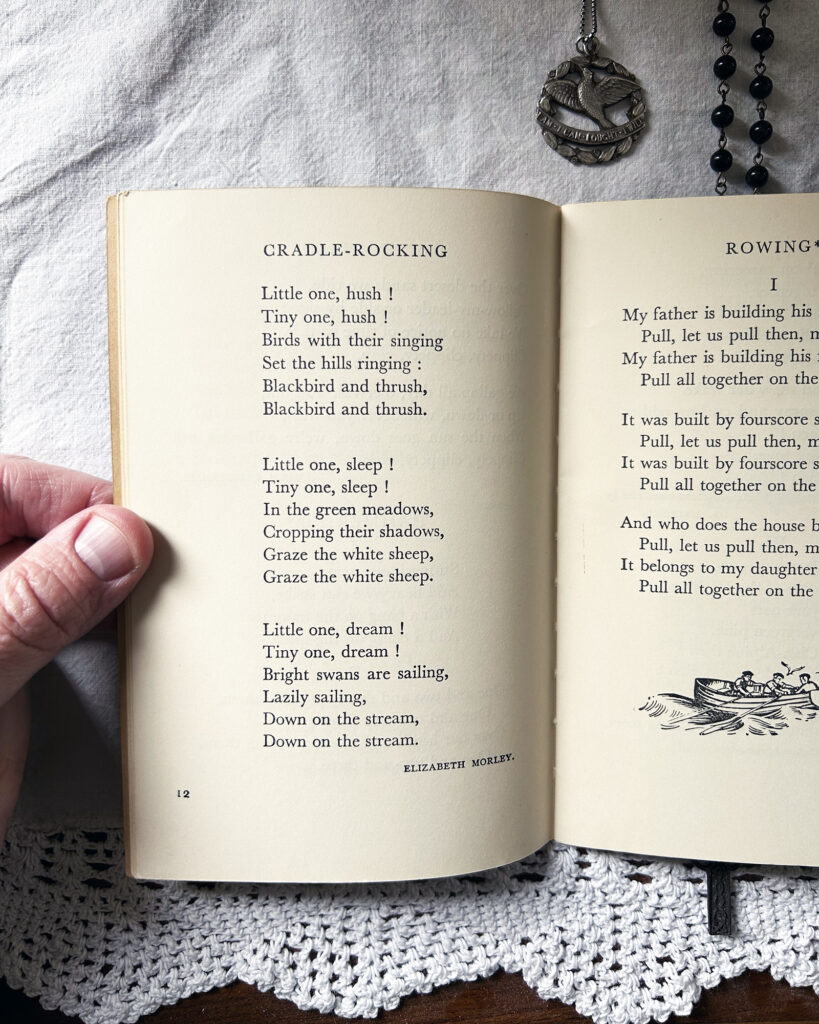
In rural Devonshire in the 1960s, a pair of sisters looked out of their bedroom window at a field full of sheep in the evening sunshine. One of the sisters then recited these words:
Little one, sleep!
Tiny one, sleep!
In the green meadows,
Cropping their shadows,
Graze the white sheep,
Graze the white sheep.
The sister who listened was not yet ten years old. But the words and the image cemented the moment in her mind.
More than sixty years later she sought to rediscover the poem that had remained in her heart. Who wrote these verses? Where could they be found? On thing she knew for sure: “Given the ‘True Poetry’ of the imagery—especially the sheep ‘cropping their shadows’—I am certain it was part of the PNEU’s curated ‘Living Books.’”
Well, we found Elizabeth Morley’s lovely poem “Cradle-Rocking.” The words exactly match what this PNEU homeschooler had remembered her entire life, even though she may have never before seen it on a page.
It is words that sustain us, and images and sounds that are beautiful and true. For so many of us, those sources of beauty were shown us by Miss Mason. I will say again that Charlotte Mason is not my living water. But thanks be to God, she showed me where to find it.
@artmiddlekauff
May 8, 2026

If you are able, get yourself a fire pit.
It is a place where everything slows down, where you can sit and look at the flames, mull over ideas, think about life, and also hang out with friends!
In a world that can be “a lot”, we find it a much-needed place of refuge and solace.
@antonella.f.greco
May 9, 2026

Have you ever called someone by the wrong name?
I thought this was Spring vetch for the longest time, but it’s actually Vicia sativa, Common vetch or Garden Vetch.
@rbaburina
May 10, 2026
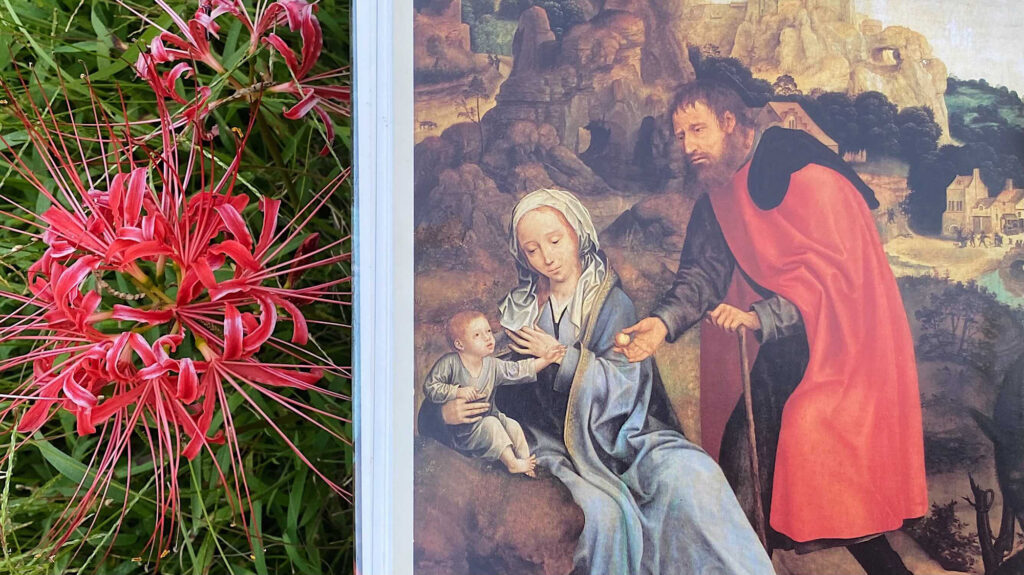
“Out of Egypt have I called My Son,” cried the prophet Hosea. His words pointed to the Exodus past and the Messiah to come. But it was not the only parallel between the childhood of Jesus and the nation of Israel:
“Just as Pharaoh had attempted to kill Moses along with all the other Israelite boys, so Herod attempted to kill Jesus along with all the young boys in Bethlehem when he realized that the Magi had not returned to give him information identifying the Christ child,” writes Tokunboh Adeyemo.
In Charlotte Mason’s poetic reflection on the Holy Innocents, she notes that secular history does not record Herod’s slaughter. But the act was certainly in keeping with the tyrant’s characater; Adeyemo explains that “The murder of thirty to forty children is only one of many outrages in his murderous reign.”
But the death of each individual child mattered to someone. In fact, the weeping has echoed from countless centuries past in the voice of another prophet, Jeremiah.
Too small for history, but not too small God. “He trusted teenagers with his son,” writes Adeyemo. “He did not shield his son from the ravages of political life. But in all these things his will was fulfilled. God may well be working out his purposes even in the seemingly insignificant acts of our lives.”
Read Mason’s poem of tragedy and hope, or listen to the recitation by @antonella.f.greco here.
@artmiddlekauff
🖼️: The Rest on the Flight to Egypt by Quentin Massys