CMP Review 2026-05-21
May 21, 2026
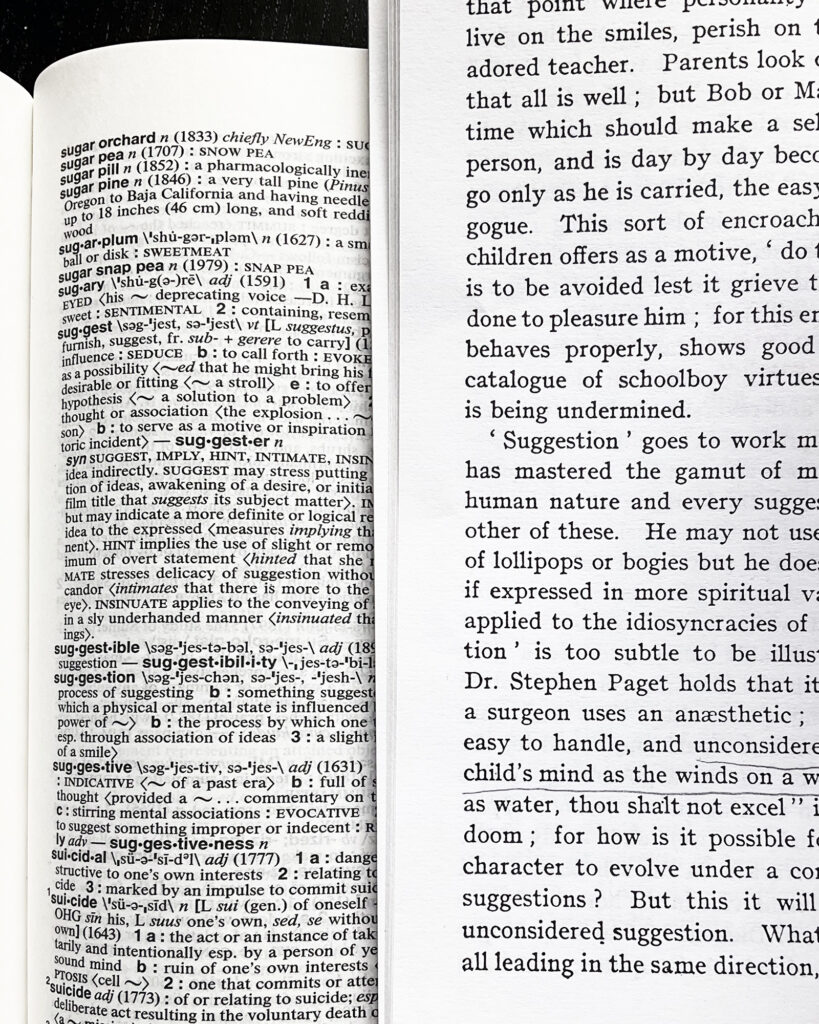
“I want to know what suggestion is, so that I can avoid it.”
This was the gist of an Idyll Challenge question that was prompted by Miss Mason’s stern warnings about suggestion in chapter 5 of volume 6. If we look at the dictionary definition (Concise Oxford English Dictionary), however, suggestion doesn’t seem to be so bad:
suggestion: an idea or plan put forward for consideration
A teacher apparently had this definition in mind when, according to Elsie Kitching, she wrote, “What is the harm of suggestion? … Don’t we all ‘suggest’ when we give children new ideas?”
To which Mason reportedly replied, “I think we may give the children the inspiration of great ideas; indeed we must do so…”
Suggestion in this first sense is fine. The harm is revealed by the fourth definition in the Oxford Dictionary:
suggestion: the influencing of a person to accept a belief or impulse uncritically
It turns out this is what Mason was warning against:
“… but we must not try to frame their minds towards those ideas.” Instead of,—‘is it not lovely to begin lessons?’ would it do to say, ‘we all want to learn a great deal and the time has come for you to begin’… Instead of, “Of course you can carry this cup of tea—I should leave out the ‘of course you can,’ and say brightly ‘pass it without spilling.’ … The point in each case being that no appeal should be made to the child’s subjective consciousness; let him think out—beyond!”
We don’t have to be experts in psychology or hypnotism to utilize suggestion to influence behavior. But we do have to be respecters of the sacredness of personality to avoid it.
@artmiddlekauff