Outside-in or Inside-out
Education and the Child Who Is a Person
My son Palmer was wrapping up his sophomore year in college. He was near the end of his last pure math class, Calculus 4, and I was there with him to the end, learning with him, supporting him, tutoring him. The very last topic was Laplace transforms. It was mind-blowing for both of us, but especially for me.
His little brother Wiles was 11 years old, and he loved math. Wiles would sit quietly and watch and listen as Palmer and I talked, explored, wondered, and laughed. Wiles loved math, and he loved his brother, and he wanted so much to be part of the conversation. I had already given Wiles glimpses of math way beyond his grade level and taught him advanced topics in a pretty unorthodox way. But Laplace transforms was going too far. I had to say, “Wiles, I just can’t explain this to you now. You’re going to have to wait.”
In fact, he needed more than just glimpses of advanced math. He needed mastery, and I had to draw the line somewhere. Finally I said, “Wiles, I’m not going to introduce Laplace transforms to you until you’re completely done with high school math.” But how would we know when he was done? I would have him take the hardest high school math test there is. Then I would know he was done and we could responsibly move on. So I made a plan.
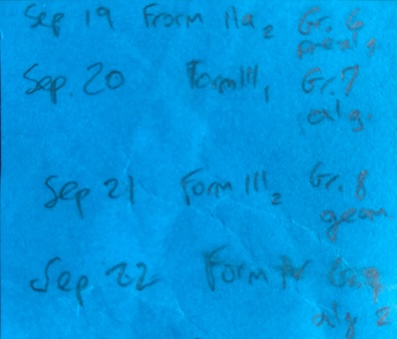 I wrote it on a Post-it note. I saved a picture of it. It was June of 2019. Here was my plan.
- September 2019, begin pre-algebra
- September 2020, algebra
- September 2021, geometry
- September 2022, Algebra 2
- 2023, precalculus
- 2024, calculus
- and then the exam in May 2025
- and then Laplace transforms.
A six-year journey. How hard could it be? This was my third and last homeschool student. I had taken my first son to calculus. I had taken my daughter to calculus. It was just a matter of training. The only difference was this time there would be a test. The hardest standardized high school math test there is. The Advanced Placement Calculus BC exam. I rolled up my sleeves. I had six years to go, and it was time to get to work.
In the late 5th century BC, a son was born to a proud and noble family in Athens, Greece. The boy had two older brothers, and they all claimed to be descended from Codrus, the legendary last king of Athens. This son was born when Athens was at war with Sparta, and the war continued through his entire childhood. His brothers fought valiantly and distinguished themselves at the battle of Megara in 409 BC. The war did not end until the boy had reached his early twenties. The war had left epidemics and famine in its wake, and it triggered a civil war. Two of the young man’s uncles seized power, but their rule was short-lived, and they both lost their lives. When a new regime took power, the young man left Athens, perhaps out of fear for his own life. The only world he had ever known was a world of war and strife. Everything just seemed to go from bad to worse.
He began to daydream and imagine a better world. Could there exist a perfect state or perfect society that resists the relentless cycle of corruption, decay, and degeneration? Eventually he concluded that just a state could exist, and he wrote a magnum opus to describe it. In around 366 BC he wrote:
The greatest principle of all is that nobody, whether male or female, should be without a leader. Nor should the mind of anybody be habituated to letting him do anything at all on his own initiative; neither out of zeal, nor even playfully. But in war and in the midst of peace—to his leader he shall direct his eye and follow him faithfully. And even in the smallest matter he should stand under leadership. For example, he should get up, or move, or wash, or take his meals … only if he has been told to do so. In a word, he should teach his soul, by long habit, never to dream of acting independently, and to become utterly incapable of it.[1]
The author of these words is Plato. In this quote, Plato describes two ways a human being can operate. One way is what I call “outside in.” In this mode, the person looks outside to his leader to direct his every action. The other way is what I call “inside out.” In this mode, the person looks inside to his own initiative to act independently.
Plato’s strong preference for the “outside in” mode had profound effects on his philosophy of education. British philosopher Karl Popper wrote in 1945:
[Plato’s] educational aim is not the awakening of self-criticism and of critical thought in general. It is, rather, indoctrination—the moulding of minds and of souls which … are ‘to become, by long habit, utterly incapable of doing anything at all independently’.[2]
“Outside-in” education is based on the concept of molding. Molding is using outside force to change something into the form you want it to be. Why was molding into a form so important to Plato? Because Forms were so important to Plato. Plato looked around him and saw everything in a state of change, degeneration, and decay. Again quoting Karl Popper:
The things in flux, the degenerate and decaying things, are … the offspring, the children, as it were, of perfect things. And like children, they are copies of their original primogenitors. The father or original of a thing in flux is what Plato calls its ‘Form’ or its ‘Pattern’ or its ‘Idea’. … we must insist that the Form or Idea, in spite of its name, is no ‘idea in our mind’; it is not a phantasm, nor a dream, but a real thing.
It is, indeed, more real than all the ordinary things which are in flux, and which, in spite of their apparent solidity, are doomed to decay; for the Form or Idea is a thing that is perfect, and does not perish.[3]
So, what he is saying is, look around you. Everything you see is a decaying, imperfect descendant of a perform Form. Education is the process of molding human beings into the perfect Form, a Form that is more real than human beings themselves. Plato also believed that there was a perfect state or society, the Form of the state. The reason he saw so much chaos in his life is because the state just kept getting worse and worse, farther and farther away from the Form. The only hope for mankind was to get society back to the Form, the perfect state.
That perfect state is called The Republic.
Plato describes … the constitution of the Republic as ‘the highest form of the state’. In this highest state, he tells us, ‘… everything possible has been done to eradicate from our life everywhere and in every way all that is private and individual… Our very eyes and ears and hands seem to see, to hear, and to act, as if they belonged not to individuals but to the community. All men are moulded to be unanimous in the utmost degree…’[4]
Since every eye, ear, and hand belongs to the community, education is not individualized. Education is a function of the state, as Vasiliki Karavakou explains:
Education is exhausted to the act of simply conserving, under the supervision of the vigilant philosopher king, the structure of a just political state.[5]
Plato taught that there were two main instruments of education for molding young people. Karl Popper explains:
The two disciplines in which children of the Greek upper class were educated, gymnastics and music (the latter, in the wider sense of the word, included all literary studies), are correlated by Plato with the two elements of character, fierceness and gentleness. ‘Have you not observed’, asks Plato, ‘how the character is affected by an exclusive training in gymnastics without music, and how it is affected by the opposite training? … Exclusive preoccupation with gymnastics produces men who are fiercer than they ought to be, while an analogous preoccupation with music makes them too soft… But we maintain that our guardians must combine both of these natures … This is why I say that some god must have given man these two arts, music and gymnastics; and their purpose is not so much to serve soul and body respectively, but rather to tune properly the two main strings’, i.e. to bring into harmony the two elements of the soul, gentleness and fierceness. ‘These are the outlines of our system of education and training’, Plato concludes in his analysis.[6]
I find it so interesting that music and gymnastics are not to serve the soul and body but to tune them. Serving would be to feed or nourish soul and body. Tune on the other hand is to mold soul and body. In fact it sounds a lot to me like “ordering the affections.” Music and gymnastics can help us order the young person’s affections so there is a proper balance between gentleness and fierceness. Why fierceness? Because every citizen in the Republic is a soldier.
When does the molding end? When does the child think for himself? In other words, when is dialectic introduced? In Plato’s model, the answer is not until he’s an old man:
‘When their bodily strength begins to fail, and when they are past the age of public and military duties, then, and only then, should they be permitted to enter at will the [field of … dialectical studies] …’ Plato’s reason for this amazing rule is clear enough. He is afraid of the power of thought. ‘All great things are dangerous’ is the remark by which he introduces the confession that he is afraid of the effect which philosophic thought may have upon brains which are not yet on the verge of old age.[7]
Now a core idea that runs through Plato’s applied philosophy is mimesis. This is a Greek word that in its most basic form means imitation. But this word “took on special significance in cosmology,” according to Wilhelm Michaelis. In Plato’s cosmology:
Reality is regarded as an imitation of the idea; time imitates eternity…; the visible is a mimema of the invisible… Men must also exercise mimesis…[8]
But it’s not a voluntary imitation. It’s in the nature of reality to conform to the form. It’s in the nature of a person to conform to the republic. Michaelis continues, “obedience is the (more or less compulsory) development of an existing disposition.”[9] The mimesis model of education is an outside-in enforcement of compulsory imitation.
This results in what I call Plato’s ladder of mimesis:
- The form shapes reality.
- Reality shapes the republic.
- The republic shapes the teacher.
- And finally, at the bottom of the ladder, the teacher shapes the student.
The student can’t help but imitate, or conform to, this weight of outside-in pressures, originating in the perfect Form.
Plato’s perfect republic was never implemented. But about 2000 years after Plato’s death, a German pastor visited a republic. His name was Valentine Andreae, and here’s how he described the republic he visited:
There is in [this republic] the perfect system of a perfect government; but the city’s special beauty is a moral discipline which makes weekly investigations into the behaviour of the citizens, including their smallest transgressions. The discipline is carried out first by district inspectors, then by the elders, and finally by the magistrates, according to the nature of the sin and the moral condition of the offender. All cursing, swearing, gambling, luxury, strife, hatred, and deceit are forbidden, while greater sins are hardly even heard of. What a glorious beauty of the Christian faith shines forth in such purity of moral conduct![10]
The incredible moral discipline of the citizens of this republic was enforced by a group called the Consistory. They didn’t concern themselves only with the commission of sins. They also made sure that the citizens of the republic avoided opportunities to sin.
Here’s a famous example. A few years after Valentine Andreae’s visit to the republic, a 23-year-old woman named Suzanne received a visitor named Vincent. The problem was that Vincent was 36 years old, married, and a father of two. Now during the visit, they just talked. They did not commit a sin. But it created a risk. An opportunity to sin. The visit was reported to the Consistory which conducted an investigation. Suzanne was told never to receive visits from Vincent again.
Then Suzanne got in trouble for going to the street theater disguised as a peasant. Witnesses claimed that she excused herself by saying, “I just disguised myself so that Vincent wouldn’t see me!”[11] But the Consistory did not approve. Maidens were not to disguise themselves as peasants.
Suzanne got the message. She avoided Vincent and 9 years later, at age 34, she got married in honorable circumstances. She gave birth to a son, but she tragically died only 9 days after the birth. But Suzanne’s little boy grew up in this perfect republic. He was a voracious reader, and one of his favorite books was Plutarch’s Lives. From Plutarch he learned about citizenship, and he recalled later that “the conversations between my father and myself to which it gave rise, formed in me the free and republican spirit.”[12]
As an adult, he wrote a letter to his republic. It was a letter “to the Republic of Geneva.” The republic whose Consistory had been established by John Calvin. Here’s what Suzanne’s son wrote to the Republic of Geneva:
Henceforth it is for you alone, not to create your happiness, since your ancestors have saved you the trouble, but to make it lasting by the wisdom of using it well. It is upon your perpetual unity, your obedience to the laws, and respect for their ministers that your preservation depends.[13]
This sounds very outside-in. The republic, the Consistory, will save you.
But this statement was immediately followed by a critical caveat, which changed Western civilization forever:
I implore all of you to look deep into your hearts and consult the secret voice of your conscience.[14]
Why was this statement so radical? Because this man was saying that the ultimate authority is not the Consistory; it’s not the republic; it’s not the state; it’s not anything outside of your own heart. This man was saying that ultimate authority is within.
The man who wrote this, Suzanne’s son, born into the perfect republic of Geneva, this man’s name was Jean-Jacques Rousseau.
Now why would Rousseau take the exact opposite view from Plato and say that the inner voice of private judgement, rather than the outer voice of the state, is the supreme authority? Here’s why:
Everything is good as it leaves the hands of the Author of things; everything degenerates in the hands of man.[15]
Why can’t we give our final trust to a republic, a consistory, a state, a church, a school? Because all of these are institutions of man. And everything degenerates in the hands of man. This one idea changes everything.
Let me give you just one example. Plato said that in the perfect republic, the state educates the children. So children should be taken from their mothers at birth:
Since all property is common property, there must also be a common ownership of women and children. No member of the ruling class must be able to identify his children, or his parents. The family must be destroyed…[16]
Why? It makes perfect sense in his system. Only the state can properly mold children from the outside in.
But Rousseau said the exact opposite:
A child ought to know no other superiors than his father and his mother.[17]
There is no substitute for maternal solicitude.[18]
Let women once again become mothers, men will soon become fathers and husbands again.[19]
[The child] will be better raised by a judicious and limited father than the cleverest master in the world; for zeal will make up for talent better than talent for zeal.[20]
The first education is the most important, and this first education belongs incontestably to women; if the Author of nature had wanted it to belong to men, He would have given them milk with which to nurse the children.[21]
Rousseau said look into your heart and listen the secret voice of conscience. And this changed everything.
Canadian philosopher Charles Taylor wrote in 1989:
Rousseau immensely enlarged the scope of the inner voice. We now can know from within us, from the impulses of our own being, what nature marks as significant.
And our ultimate happiness is to live in conformity with this voice, that is, to be entirely ourselves.[22]
Charles Taylor coined a new word to describe what Rousseau represents. If Plato is mimesis, then Rousseau is poiesis. “I … coin this neologism,” said Charles Taylor:
What I am getting at is the new centrality of constructed orders and artifacts in mental and moral life.[23]
Mimesis and poiesis is a great way to summarize the grand difference between the paradigm of Plato and the paradigm of Rousseau. Now even though Charles Taylor coined the term in 1989, you can see the idea in philosophers who came before him. One of my favorites is Sir Frederick Clarke of the University of London. One reason I like him so much is that his work appeared in a journal I love.
His magisterial article “The Conflict of Philosophies” was printed in The Parents’ Review in 1936, while Elsie Kitching was the editor. Sir Clarke described the grand conflict between two titanic philosophies, and guess what they were?
Plato versus Rousseau.
He didn’t use the words mimesis and poiesis, but that’s what it was all about. Now interestingly, although his article is about the conflict between these two philosophies, he begins by talking about what they have in common:
But neither Plato nor Rousseau is as one-sided as so sharp an antithesis would suggest, an antithesis better suited to the conflicts of doctrinaire partisans than to the rounded thought of moral philosophers.[24]
So let’s be moral philosophers and find out what Sir Clarke said Plato and Rousseau had in common. I’ll point out what I think are the big 3:
(1) They both believed that original sin is the cause of all the problems we see around us. Clarke said, “in both cases the diagnosis was one of moral weakness and evil in men as men.”[25] “[Rousseau] knew his own heart too well to have any doubt of the real origin of the evils he saw in the society around him.”[26]
(2) They both believed that moral effort is required to improve our situation. Clarke said:
with both Plato and Rousseau all the emphasis falls on sustained moral effort as the essential condition of the well-being of men. Thus education is first and foremost an education of the will; civil society itself exists only as the expression of collective moral effort, and continues to exist only in so far as conscious ‘virtue’ in the individual citizen guarantees its continuous renewal.[27]
(3) They both believed that authority is natural, necessary and fundamental. Clarke said:
Both … were concerned with the establishing of the authority of the Good. (It is a mistake to assume, as is still often done, that Rousseau shirked the problem of Authority. On the contrary, his whole quest was to find a form of authority which would save and guarantee the substance of freedom, For him it is ‘not a question of power one is forced to obey, but of that which one is obliged to recognise.’)[28]
The very idea of education, as the directing of the processes by which the immature achieve maturity of a determinate shape, implies authority. Rousseau himself leaves us in no doubt on the point.[29]
But… according to Clarke, where Plato and Rousseau disagreed is on how that moral effort and authority should be applied. Plato taught that the republic (or the community, or the school, or the church, or the state) should mold corrupt man from the outside in, into the ideal image. Rousseau on the other hand taught that no institution of man has the right to mold, control, or form a human being. Instead, he taught that a person must develop judgement to escape corruption from the inside out.
According to Clarke, this has a profound effect on education. He said that in Plato’s model the goal of education is for “society to perpetuate itself in the type.”[30] In Rousseau’s model, the goal of education is “to confirm individual selves in a competent, independent judgment which is essentially their own.”[31]
Plato, he said, leads to an “increase of externalism,”[32] and the “externalising of values and of the influences by which life is determined.”[33] Rousseau leads to “an increase of inwardness,”[34] to “produce fully integrated personalities with their own inner sources of strength and autonomous cohesion.”[35]
This has direct implications on the nature of the authority of the teacher. For Plato, says, Clarke, the authority of the teacher is “absolute.”[36] For Rousseau, the authority of the teacher is “contingent like that of the physician.”[37] For Plato, the teacher is “the functionary of an imposed régime.”[38] For Rousseau, the teacher is “the free disposer of the instruments and sustenance of Personality.”[39]
Plato’s model is fundamentally conservative: “Growth beyond the type is the unpermissible thing.”[40] Rousseau leaves the door open to reform: the student can become “more than a type—a Person—and so to react fruitfully, if critically, upon the society which has produced him.”[41] In other words, Plato represents mimesis. Rousseau represents poiesis.
And according to philosophers such as Frederick Clarke, Carl Trueman, Karl Popper, Charles Taylor, and many others, these are real and important differences, and educators have to make a choice. Many philosophies of education have that choice built in.
For example, let’s consider classical education. Classical education is based on mimesis.
Mitchell Holley is the Headmaster of the Memoria Academy and is an expert in classical education and classical languages. He said:
Classical education would say that a child is someone that needs to be formed.[42]
And he said:
I like the Greek view that all kids are barbarians and they are a threat to civilization… and left untrained then they will destroy the city.[43]
Do you see the influence of Plato here? The idea is that the corrupt individual is a threat to the healthy republic, rather than that the corrupt republic is a threat to the healthy individual. The idea is that the republic is the agent for forming the individual, rather than that the individual is the agent for reforming the republic. He says:
The classical tradition has always said that there is a world out there and the children are not above that world … they have to be trained to orient themselves, and be subjugated to what’s real.[44]
And the Greeks had a word for formation, paideia… And … there was nothing free about it. There was a curriculum, and there was a way of doing that curriculum. And … in order to gain the freedom of thinking and the freedom of thought, you had to first sit at the table of paideia, let paideia do that good work to you. And then after you’ve graduated from that school, from that formation, then you can engage in free thinking. But it first requires submission. It does not require freedom. You only acquire the freedom after you’ve submitted… We’re still trying to fit them to a mold, not allowing them to determine what the mold is.[45]
Do you see how this lines up with Plato? Remember Plato’s “educational aim is … the moulding of minds and of souls.”[46]
This has implications for everything, including the curriculum, the method of instruction, and the role of the teacher.
Holley explains the curriculum of classical education:
Skills have to be inculcated … in the classical tradition. And that’s why, going back to the Middle Ages, there were all these manuals on how to teach grammar and logic and rhetoric, because the classical tradition has always said that you are not born with those skills, that there’s a qualitative and quantitative difference between the mind of a child and the mind of an adult. And in order for that, the mind of the child has to be shaped and curated and developed.[47]
The method of instruction is mastery. Paul Schaeffer, Director of the Classical Latin School Association says:
We want Mastery. The only way you get mastery is by going through the same thing over and over and over again.[48]
Holley says that classical education involves “questioning, rereading, summarizing, writing a thesis … narration is one of those things.”[49]
The role of the teacher in classical education is inherently teacher-driven. Martin Cothran is the director of the Classical Latin School Association, and he says:
Your impetus for learning [comes] from the teacher… the teacher is somebody you admire, and you want to be like them.[50]
Classical education traces its roots all the way back to Plato. So of course its philosophy follows the model of mimesis, or outside in.
Well, about Charlotte Mason and the PNEU?
Let’s start with Sir Clarke and his 1936 Parents’ Review article. After his careful study showing where Plato and Rousseau align and where they differ, he wrote the following:
If, in conclusion, we revert to the two great exponents of our Western philosophy … we shall have to admit that, in the last resort, we are with Rousseau rather than with Plato.[51]
Thomas Rooper, who Charlotte Mason celebrated in the last chapter of Formation of Character, wrote in the 1896 Parents’ Review:
Rousseau [is] the father of modern educational principles…[52]
In The Parents’ Review in 1906, we read about a lecture by a Miss Shakespeare to a PNEU branch:
[Miss Shakespeare] then went on to Rousseau, pointing out that he was the first to recognise that children are born persons, and how from his day onward the ideas about children had been gradually changing until to-day … the rights of children were recognised, their individuality was given room to expand, and they were treated with a wise and thinking love.[53]
OK but what about Mason herself? What does she say? In her 1910 paper “Two Differing Ideals and a Danger,” she wrote:
most of us who have theories of education derive them consciously or unconsciously from Rousseau…[54]
He was the avant courier of revolutionary thought; he preached liberty in an age of tyranny, due self-regard in an age of undue subjection, and the right of children to share in all the noble conceptions in the air…[55]
he is for all time; what gratitude do we all owe to the genius who set courtly mothers to the nursing of their own babies, who told every father that … the father who brings children into the world has not only the duty of supporting them but of educating them himself. How wise! we say, and we are right…[56]
as long as education remains the concern of most men and women, we shall continue to follow his lead.[57]
If Mason is following his lead, we should expect to see poiesis rather than mimesis in her writing. We should expect to see inside-out rather than outside-in. And what do we see?
the true educationalist works from within outwards[58]
A person is not built up from without but from within, that is, he is living, and all external educational appliances and activities which are intended to mould his character are decorative and not vital… let us consider a few corollaries of the notion that ‘a child is a person,’ and that a person is, primarily, living… life is sustained on that which is taken in by the organism, not by that which is applied from without.[59]
Charlotte Mason resists the idea of molding, the outside-in approach emphasized by Plato. She quotes Henry Latham who cites the example of Christ Himself:
‘Our Lord,’ says [Henry Latham], ‘reverenced whatever the learner had in him of his own, and was tender in fostering this native growth… Men, in His eyes, were not mere clay in the hands of the potter, matter to be moulded to shape. They were organic beings, each growing from within, with a life of his own—a personal life which was exceedingly precious in His and His Father’s eyes…’[60]
One goal of Classical Education is to “order the affections.” The idea is that the child comes to us with disordered affections, and that through outside molding, we can fix the order of the affections. But Charlotte Mason says that the affections order themselves:
We do not talk about developing his faculties, training his moral nature, guiding his religious feelings, educating him with a view to his social standing or his future calling… We take the child … as we find him—a person with an enormous number of healthy affinities, embryo attachments; and we think it is our chief business to give him a chance to make the largest possible number of these attachments valid.[61]
This affects the curriculum. How do we decide what should be included in the curriculum? Amazingly, Charlotte Mason does not say to look to civilization or a received tradition to find what should be in the curriculum. That would be to start from the outside.
Charlotte Mason says to start from the inside. She says to start with the child, and see what is inside him. Principle 12 says:
a child has natural relations with a vast number of things and thoughts: so we train him upon physical exercises, nature lore, handicrafts, science and art, and upon many living books, for we know that our business is not to teach him all about anything, but to help him to make valid as many as may be of—
“Those first-born affinities
That fit our new existence to existing things.”[62]
That quote, “those first-born affinities,” is from Wordsworth. When it comes to defining the curriculum, Charlotte Mason cites Wordsworth, not Plato. She says:
what if in the very nature of things we find a complete curriculum suggested?[63]
Do you see you radical this is? She is saying to look at the nature of things, the way things are, before they got corrupted by man. Here’s what immediately follows that quote:
A small English boy of nine living in Japan, remarked,—“Isn’t it fun, Mother, learning all these things? Everything seems to fit into something else.” The boy had not found out the whole secret; everything fitted into something within himself.[64]
This has great implications for the method of instruction. The fundamental idea is that all education is self-education. Charlotte Mason says:
we [used to] persist in applying education from without as a bodily activity or emollient. We begin to see light. No one knoweth the things of a man but the spirit of a man which is in him; therefore, there is no education but self-education[65]
This is not some abstract thing. Charlotte Mason talks about the impact when methods are changed according to this idea:
we have only to put books of literary value into his hands and let him deal with them in his own way, only securing that he knows by requiring him to tell what he has read. This telling shows that a spiritual process has taken place; something new, some little touch of originality, some quaint expression, shows that spontaneous mental activity has been set up; and from this, which would seem to be a small change in the methods of a school, the results are rather extraordinary.[66]
The key, she says, is that “The children, not the teachers, are the responsible persons; they do the work by self-effort.”[67]
Mason’s radical claim is that when given the right books, an almost miraculous change takes place, from the inside out:
our function as teachers is to supply children with the rations of knowledge which they require; and that the rest, character and conduct, efficiency and ability, and, that finest quality of the citizen, magnanimity, take care of themselves.[68]
We have authority as teachers to assign books to read, to set up the time table, to require a narration. But we don’t have the authority to decide what children will learn from their books. That right belongs to them. She says:
Probably [the child] will reject nine-tenths of the ideas we offer, as he makes use of only a small proportion of his bodily food, rejecting the rest. He is an eclectic; he may choose this or that; our business is to supply him with due abundance and variety and his to take what he needs. Urgency on our part annoys him. He resists forcible feeding and loathes predigested food.[69]
Now this should take some pressure off your shoulders. Your job as a teacher is so much easier than you thought. Charlotte Mason says:
You may bring your horse to the water, but you can’t make him drink; and you may present ideas of the fittest to the mind of the child; but you do not know in the least which he will take, and which he will reject… Our part is to see that his educational [plate] is constantly replenished with fit and inspiring ideas, and then we must needs leave it to the child’s own appetite to take which he will have, and as much as he requires.[70]
Charlotte Mason completely changes the role of the teacher:
the whole intellectual apparatus of the teacher, his power of vivid presentation, apt illustration, able summing up, subtle questioning, all these were hindrances and intervened between children and the right nutriment duly served; this, on the other hand, they received with the sort of avidity and simplicity with which a healthy child eats his dinner.[71]
There is no scaffolding, no defining of words beforehand, no lesson objectives, no study guides, no books to buy to tell you how to read a book. Instead:
the child and the author must be trusted together, without the intervention of the middle-man. What his author does not tell him he must go without knowing for the present. No explanation will really help him, and explanations of words and phrases spoil the text and should not be attempted unless children ask.[72]
We do not even interpret works of art to the child:
As in a worthy book we leave the author to tell his own tale, so do we trust a picture to tell its tale through the medium the artist gave it. In the region of art as elsewhere we shut out the middleman.[73]
Who’s the middleman? Us. We’re the middleman.
Plato said the person “should teach his soul, by long habit, never to dream of acting independently, and to become utterly incapable of it.”[74] But Charlotte Mason says:
A single decision made by the parents which the child is, or should be, capable of making for itself, is an encroachment on the rights of the child, and a transgression on the part of the parents.[75]
It’s a radical respect for personhood. As my friend Dr. Benjamin Bernier wrote:
[It] exclude[s] every sectarian form of indoctrination, because of the sanctity of the person which it implies and the placing of the child above the institution and the system.[76]
The child above the institution? The child above the system? Is this Plato? No, it’s the exact opposite.
So then is a Charlotte Mason education the same thing as a Rousseau education? I mean, they both emphasize inside out, so is Charlotte Mason’s model the poiesis that Charles Taylor described?
Carl Trueman is a British professor of theology and church history. And in 2020 he published a book that the Gospel Coalition said was the “the most important cultural book of the year (maybe even [of the] decade).”[77] The book has an in-depth discussion on mimesis and poiesis. In the middle of that section, Trueman has this amazing passage:
if I ask what it would be like to be me if I had been born not in Dudley, England, to English parents but rather in Delhi to an Indian mother and father, the question is really impossible to answer for a very simple reason: I would then have been not me but someone completely different.[78]
His point is the great power of mimesis. It is so great, he says, that what is outside makes him “me,” not what is inside.
Well, what if Mr. Trueman had been born in Jericho in 1400 BC to Canaanite parents? What if he had been trained from the cradle to worship Baal? Then would he cease to be “me”?
There once was a woman who was born in Jericho. Mimesis told her who she was.
It was outside in. She was a Canaanite and a pagan. Her city, her state, her school, and her parents all molded, shaped, and formed her identity around three pillars: Canaan, Jericho, Baal.
What about poiesis? What inner voice did she follow? We don’t know for sure, but whatever that voice said, it told her to become a prostitute.
And then a terrifying threat came. An army was approaching. “Jericho was securely shut … none went out, and none came in.”[79] Civilization was at stake. The state was at stake. The family was at stake. All true citizens were to stand together to fight for their identity.
Remember who you are. You’re a Canaanite. You’re a pagan.
But then she heard words.
She “heard how the Lord dried up the water of the Red Sea.”[80]
She heard “what [a nation] did to the two kings of the Amorites who were on the other side of the Jordan, Sihon and Og, whom [they] utterly destroyed.”[81]
These living ideas came into her heart. She heard. And then she knew.
Two enemy spies from this nation came to her. And what did she say? She said:
I know that the Lord has given you the land …[82]
… the Lord your God, He is God in heaven above and on earth beneath.[83]
She heard, and then she knew.
The woman’s name was Rahab. How did she know that Yahweh is God in heaven above and on earth beneath?
Was it mimesis? No, state, culture, family, religion all taught her the opposite.
Was it poiesis? No, she looked inside herself and saw only a piece of property to be bought and sold.
No, what transformed her was neither mimesis nor poiesis.
It was theosis. I use this word in the most ecumenical sense, in the sense that all Christians can agree with:
theosis is what Paul tells us in Romans 12:2: “Do not conform any longer to the pattern of this world, but be transformed by the renewing of your mind.”[84]
This definition comes from Michael Houdmann. At the heart is Romans 12:2: We are not to be conformed to an outside pattern. We are to be transformed by an inside renewal.
Else Kitching was Charlotte Mason’s closest companion and most trusted interpreter.
And she wrote:
P.N.E.U. philosophy … offers principles upon which the formation of character should be based.[85]
Well, what are those principles? Elsie Kitching wrote:
The Gospels are full of studies of character training. The story of the Samaritan woman, for instance, illustrates our Lord’s method of dealing with the question of character. The woman is bad, but He looks at the eager and intelligent mind behind her boldness. There is no word of “being good” or “being bad.” He sets her mind to work on a new idea, gives her knowledge. When her attention is arrested He calls forth a confession of her sin and its consequences but does not dwell upon it, and then proceeds to fill her mind with the most profound knowledge man can know. She recognises “the Christ” and immediately leaves her waterpot—a note of return—and goes to spread the good news. We know no more of her, but we do know that the act of recognition is faith, and we may believe that in her case too,—”thy faith hath saved thee.” Our Lord always taught those who came to Him for whatever reason. He challenged the attention of each one by an appeal to the mind, He then fed the mind and let it work. … St. Paul’s comment is,— “Be ye transformed by the renewing of your mind.”[86]
So Jesus meets the Samaritan woman. She’s not in a good place. But He doesn’t try to mold or shape her from the outside. Instead, He feeds her mind and lets it work. She hears the word and then she is transformed, by the renewing of her mind.
But this renewing of the mind is not a mere cognitive activity. Something else is going on.
Michael Houdmann continues his definition of theosis:
Theosis … is the transformation that takes place within the believer. But it is really more than that. This transformation is made perfect through … the Holy Spirit which resides within us.[87]
Charlotte Mason said that the Holy Spirit is the supreme educator of mankind. When Rahab hears about Yahweh, the Holy Spirit speaks to her heart. When the Samaritan woman hears about living water, the Holy Spirit speaks to her heart. And when you share living ideas with your child, the Holy Spirit speaks to his heart. The Holy Spirit brings the living ideas of Christ to all peoples of all times and all places — Jericho in Canaan, Delhi in India, Dudley in England, … and your home school in the United States.
Reverend Francis Lewis was a close friend of Miss Mason who often preached at her church in Ambleside. In one of his sermons he explained how transformation works from the inside out as the soul responds to God. He said:
Faith is the response of the soul to the leading, and calling of God. It springs from within, not from without.[88]
It is such a temptation for me to try to take matters into my own hands. To do the work of transformation and of teaching myself. But Reverend Lewis reminds me:
The minister can only plant and water, it is God who gives the increase.[89]
Still it is such a temptation for me to try to take matters into my own hands. To do the work of transformation and teaching myself. To do what Helen Wix warns of:
the attitude of mind in the teacher who says, “I’ll see to it that you shall learn it properly.” He is thus taking upon himself … the … burden…[90]
This was the attitude in my mind when we began preparing for the Advanced Placement Calculus BC test. My third and final homeschool child. My final exam. I can do this. Don’t worry son, I’ll see to it that you shall learn it properly.
The first sign of trouble came only about a week after I signed him up for the exam. It was October 17, 2024 and the exam was May 6, just over six months away. I remember vividly that day, when I actually opened up the official description of the AP exam. You know, I had read about the exam, in unofficial sites. They said the BC exam had just a few topics beyond what is normally covered in high school calculus. But this was the first time I looked at the official guide.
My heart sank.
I looked at the units to be covered, and I saw whole units that I had not only never taught before, but I had never seen myself. I felt a surge of panic. But it lasted for only a moment. How hard can it be, I thought. It’s just math. I can learn it. And once I’ve learned it, I can make him learn it. Just like Helen Wix warned. “I’ll see to it that you shall learn it properly.”
The six-month timer began its countdown.
I divided the material into three separate tracks that were quite independent. That way we were able to have three 30-minute math lessons per day, one per track. These were Charlotte Mason style math lessons. I have to say that they were a delight. And some of those times of discovery and exploration of math with my son were some of the best moments of my home school experience.
But as I learned about public school classes preparing for the exam, I began to realize what a challenge I had signed up for. I learned about the AP industry. The AP factory. Experienced high school teachers who had AP test prep down to a science. They had taken students through the program year after year. They molded their students. They formed them to be able to handle every kind of question. They practiced mimesis. They had no doubts, no questions, nothing new to learn.
What on earth was I doing? I was trying to do what the career education professionals in the academy do. And I’m just an ordinary dad.
And I said, yeah, that’s right. I’ll do it. But behind that bold exterior, doubt was eating me away.
My close friends knew I was nervous. One of them asked about Wiles. Was he feeling pressure from me? I was privy to a candid conversation where someone asked him how he felt about the upcoming exam. Was he worried? He said, “I want to show that homeschooled students can do as well as anybody else.”
It was inspiring to me. But it was also terrifying. Because I felt he was also saying, “I want to show the world that you, my dad, can teach math just as well as anybody else.”
The weeks went on and the units got harder. And I was pushed to the limit of my ability. But I was still managing. Until about a month before the exam. We got to Taylor series. I went to my trusted calculus book and I read about it. And I could not understand it. My favorite calculus author. I could not get it. But this kind of thing had happened to me before.
When it happens, I open the book and leave it on the table by my bed. I read it carefully before going to sleep. And then in the morning it starts to make sense.
I read the lesson on Taylor series again right before bedtime. I left the book open by my bedside. I went to sleep and I awoke. I looked at the book expecting the light to shine. But there was no light. There was no understanding. It was as incomprehensible as the night before. Then I knew I was really in trouble.
I fell into full-blown panic. Taylor series, I learned, was not just a little thing. It was a major part of the exam. I was setting up my son to fail. Because I had failed. And it was killing me.
In desperation I decided to set aside a special day of prayer. A special day of self-denial and focus on God to seek His help, His answer, … something.
I woke up and prayed in the morning. But there was no answer.
I prayed at noon and there was no voice from heaven.
I prayed in the evening and still God did not speak.
Perhaps this was one of those times when God would remain silent, when God would say no.
I turned to my chores. I was spending 5 minutes a day on preparing episodes for the Charlotte Mason Poetry podcast. I was working on a recording by Nancy Kelly, from her 2023 talk, “Learning to Live.” I had 5 minutes. I sat at my computer, put on my headphones, I hit play, and this is what I heard.
And if you take the Holy Spirit out of her equation, and you place the onus of successful education on the shoulders of the teacher, or even the student, what you have is a form of educational legalism, carried out by human endeavor, and it will be a lifeless framework.[91]
God answered my prayer. He told me what to do. He told me to give up the lifeless framework of human endeavor. He told me to put the Holy Spirit back into the equation.
Sitting there on the floor with my Mac in my lap and my headphones in my ear, I said “yes” to God. I felt free. I felt joy. Because there was a new teacher running the program now. And that teacher was the Holy Spirit of God.
There were 24 days left before the exam. I won’t say that I let up and put less time or effort into trying to understand Taylor series and trying to help my son learn. If anything I spent more time. But the difference was that there was a sense of joy and faith that I had not experienced all year. We felt joy in the journey as we delighted in math for its own sake. All the results were in God’s hands.
In the days that followed, Taylor series yielded their secrets to me. Wiles even picked up some aspects of it faster than me. Those weeks of reveling in knowledge for its own sake were some of the best times of my life.
The day of the exam I drove Wiles to the big high school where there were hundreds of students. He had to check in at the office and get a special pass to be led through the halls. He got to the exam room and the proctor joked and said, “We have an illegal student here!” Gradually one side of the room filled up with the students who had taken their AP class together, formed by the professional and experienced AP teacher. Wiles sat on the other side alone. It was time to start and then the proctor said, “We’re still missing a few people. We’re missing Wiles Middlekauff.” And he said, “No, I’m here.”
And then it started. At first the exam proceeded just like the practice. Everything we had trained for. Every problem had its standard approach and its technique.
At first it was all multiple choice. Then it was time for the free response questions. These are not multiple choice. You have to show all your work. You are graded not only on whether you got the answer right, but also on how well you document and show your reasoning. A free response question starts with a general situation, and then there are four successive parts, each more difficult than the previous. The last free response question in the section was on polar coordinates.
Of course Wiles and I had drilled on these. Wiles knew how to do this. Part A — done, just as he was trained. Part B — a little harder, done, just as he was trained. Part C — a little harder, done, just as he was trained. Then Part D.
And he stopped dead in his tracks. This question is like nothing he had ever seen before. It made no sense. It had never come up in his training. It had never come up in his practice. His eyes moved back and forth between the incomprehensible question and the blank paper before him.
Now people had asked Wiles how he felt about this test before he took it. They asked him if he was nervous. They asked him why he wanted to take it. He said that he just wanted to prove that homeschool students could do just as well as everybody else. This was his chance. But now his training had run out. The clock was ticking.
Two minutes left. 90 seconds left. 89. 88.
His friend, his instructor, his dad wasn’t there. He was in a room of strangers. 87 seconds. 86. 85. His teacher not there to help…
… or was he? Who was his teacher? Was it his dad? Or was it the supreme educator of mankind?
His teacher was there. The Holy Spirit was right there in the room.
84 seconds. 83. 82.
Charlotte Mason said, “We allow no separation to grow up between the intellectual and ‘spiritual’ life of children, but teach them that the Divine Spirit has constant access to their spirits, and is their continual Helper in all the interests, duties and joys of life.”[92]
People often wonder what it means that the Holy Spirit is our teacher. Some people say that the Holy Spirit only teaches us spiritual things. Some people say that the Holy Spirit guides the teacher, perhaps with an inspiration or a subjective nudge. Some people say that the Holy Spirit helps the child to understand a reading or to make a connection. And some people say that the Holy Spirit speaks with a still, small voice. A voice that speaks from the inside out.
81 seconds. 80. 79.
The question says, “the rate at which the particle’s distance from the origin changes…”
“Rates…”
“A rate related to another rate?”
“Related rates! that’s it! This last section looks like it’s about polar coordinates. But it’s really about related rates!”
In that moment Wiles realized that he could apply a familiar concept in a novel and unfamiliar way.
The clock was ticking and with a surge of adrenaline Wiles grabbed his pencil. He began writing as fast as the muscles in his hand and fingers could move.
“Time’s up. Put down your pencils.”
Wiles breathed a deep sigh of relief. He gently placed his pencil beside a completely full answer sheet.
When the exam finally finished, the other students had to go back to class, but Wiles had to leave the building. The teacher asked, “Is someone coming to pick you up?”
And he said, “My dad is here.”
The teacher said, “You’ve been in here four hours. Surely your dad hasn’t been sitting in the parking lot all this time. Here, you can use my phone, and call your dad up, and let him know he can come to the school now.”
And he said, “No, you don’t understand. I know my dad is here for me.”
There in the parking lot in a sea of cars I looked over to the entrance. A door opened in the side of the building. Out of the big high school came my homeschool student. Charlotte Mason said, “the divine Spirit does not work with nouns of multitude, but with each single child.” He got in the car and I asked him how it went. He was relaxed and he smiled, and he said, “I feel good about all my answers.”
It was May 12, 2025. The next day was my birthday, and just as I had promised six years before, we sat down for our first lesson in Laplace transforms. Wiles told Barbara that he felt bad that he didn’t have a birthday present ready for me that year. Well, I said to Barbara, that lesson Wiles and I just had on Laplace transforms was the best birthday present I’ve ever received.
“If … you place the onus of successful education on the shoulders of the teacher” — mimesis — “or even the student” — poiesis — “what you have is a form of educational legalism, carried out by human endeavor, and it will be a lifeless framework.”[93]
But if you put the onus on the Holy Spirit — theosis — well … get ready for the most exciting adventure of your life.
Subscribe: Apple Podcasts | Spotify | Amazon Music
Endnotes
[1] Popper, Karl Raimund (1945/2020). The Open Society and Its Enemies (Princeton: Princeton University Press) (p. 3). Quoting from Plato’s Laws, 942.
[2] Ibid., p. 125. Quoting from Plato’s Laws, 942.
[3] Ibid., p. 24.
[4] Ibid., p. 98. Quoting from Plato’s Laws, 739.
[5] Karavakou, Vasiliki, “Let Education in the Cave: Reclaiming a Progressive Political Role for the Individual in a Modern Democracy”, in Dewey and the Ancients: Essays on Hellenic and Hellenistic Themes in the Philosophy of John Dewey, Kirby, Christopher C. (ed.) (p. 92).
[6] Popper, Karl Raimund. The Open Society and Its Enemies (pp. 50–51). Quoting from Plato’s Republic, 410–412.
[7] Ibid., p. 126. Quoting from Plato’s Republic, 497–498.
[8] Michaelis, W. (1964–). μιμέομαι, μιμητής συμμιμητής. In G. Kittel, G. W. Bromiley, & G. Friedrich (Eds.), Theological dictionary of the New Testament (electronic ed., Vol. 4, p. 661). Eerdmans.
[9] Ibid.
[10] Needham, N. (2016). 2000 Years of Christ’s Power: Renaissance and Reformation (Newly revised edition, Vol. 3, pp. 222–223). Christian Focus.
[11] Ritter, Eugène (1896). La famille et la jeunesse de J.-J. Rousseau (Paris: Librairie Hachette Et Cie) (pp. 94–95).
[12] Rousseau, Jean-Jacques (1896). The Confessions of Jean Jacques Rousseau, Vol. 1. Privately printed (p. 5).
[13] Schaeffer, Denise. Rousseau on Education, Freedom, and Judgment (p. 177). Quoting Rousseau’s The First and Second Discourses, trans. Roger D. Masters and Judith R. Masters (New York: St. Martin’s Press, 1964).
[14] Ibid.
[15] Rousseau, Jean-Jacques. Émile, or On Education, trans. Allan Bloom (Basic Books, 1979) (p. 37).
[16] Popper, Karl Raimund. The Open Society and Its Enemies (pp. 46-47). Quoting from Plato’s Timaeus, 18.
[17] Rousseau, Jean-Jacques. Émile, or On Education, trans. Allan Bloom (Basic Books, 1979) (p. 57).
[18] Ibid., p. 45.
[19] Ibid., p. 46.
[20] Ibid., p. 48.
[21] Ibid., p. 37.
[22] Taylor, Charles (1989). Sources of the Self: The Making of the Modern Identity (pp. 361–362).
[23] Ibid., p. 197.
[24] “The Conflict of Philosophies,” The Parents’ Review vol. 47, p. 288.
[25] Ibid., p. 292.
[26] Ibid., p. 290.
[27] Ibid., pp. 291–292.
[28] Ibid., p. 298.
[29] Ibid., p. 300.
[30] Ibid., p. 287.
[31] Ibid., p. 303.
[32] Ibid., p. 295.
[33] Ibid., p. 302.
[34] Ibid.
[35] Ibid.
[36] Ibid., p. 300.
[37] Ibid.
[38] Ibid., p. 306.
[39] Ibid.
[40] Ibid., p. 297.
[41] Ibid., p. 287.
[42] “Charlotte Mason Explained: A Classical Education Perspective (Part 1),” Memoria Press Podcast Network (8:01).
[43] “Charlotte Mason Explained: A Classical Education Perspective (Part 2),” Memoria Press Podcast Network (24:26).
[44] “Charlotte Mason Explained: A Classical Education Perspective (Part 1)” (15:35).
[45] Ibid., 18:08.
[46] Popper, Karl Raimund. The Open Society and Its Enemies (p. 125).
[47] “Charlotte Mason Explained: A Classical Education Perspective (Part 3),” Memoria Press Podcast Network (18:48).
[48] “Charlotte Mason Explained: A Classical Education Perspective (Part 2)” (10:20).
[49] Ibid., 17:18.
[50] “Charlotte Mason Explained: A Classical Education Perspective (Part 3)” (22:20).
[51] “The Conflict of Philosophies,” The Parents’ Review vol. 47, p. 306.
[52] “Bad Bringing Up,” The Parents’ Review vol. 6, p. 165.
[53] The Parents’ Review vol. 17, p. 77.
[54] “Two Differing Ideals and a Danger,” The Parents’ Review, vol. 21, pp. 801–802.
[55] Ibid., p. 802.
[56] Ibid.
[57] Ibid., p. 807.
[58] Parents and Children, p. 102.
[59] An Essay Towards a Philosophy of Education, pp. 23–24.
[60] School Education, p. 183.
[62] An Essay Towards a Philosophy of Education, p. xxx.
[64] Ibid., pp. 156–157.
[66] “Trop de Zèle,” The Parents’ Review, vol. 25, p. 410.
[67] An Essay Towards a Philosophy of Education, p. 6.
[69] An Essay Towards a Philosophy of Education, p. 109.
[70] Parents and Children, p. 127.
[71] An Essay Towards a Philosophy of Education, p. 11.
[74] Popper, Karl Raimund. The Open Society and Its Enemies (p. 3). Quoting from Plato’s Laws, 942a, f.
[75] Parents and Children, p. 17.
[76] Private correspondence.
[77] “The Most Important Cultural Book of the Year (Maybe Even Decade),” The Gospel Coalition.
[78] Carl Trueman, The Rise and Triumph of the Modern Self: Cultural Amnesia, Expressive Individualism, and the Road to Sexual Revolution (Wheaton: Crossway, 2020), p. 58.
[79] Joshua 6:1 (NKJV).
[80] Joshua 2:10 (NKJV).
[81] Ibid.
[82] Joshua 2:9 (NKJV).
[83] Joshua 2:11 (NKJV).
[84] Got Questions Ministries. (2002–2013). Got Questions? Bible Questions Answered. Logos Bible Software.
[85] “What’s Next,” The Parents’ Review vol. 31, p. 118.
[86] “What’s Next,” The Parents’ Review vol. 31, pp. 122–123.
[87] Got Questions Ministries. (2002–2013). Got Questions? Bible Questions Answered. Logos Bible Software.
[88] “By My Spirit,” The Parents’ Review, vol. 34, p. 601.
[89] Ibid.
[90] “Education is a Life,” The Parents’ Review, vol. 38, pp. 465–466.
[91] Kelly, Nancy (2023). “Learning to Live.”
[92] An Essay Towards a Philosophy of Education, p. xxxi.
[93] Kelly, Nancy (2023). “Learning to Live.”