CMP Review 2026-10-08
October 8, 2026
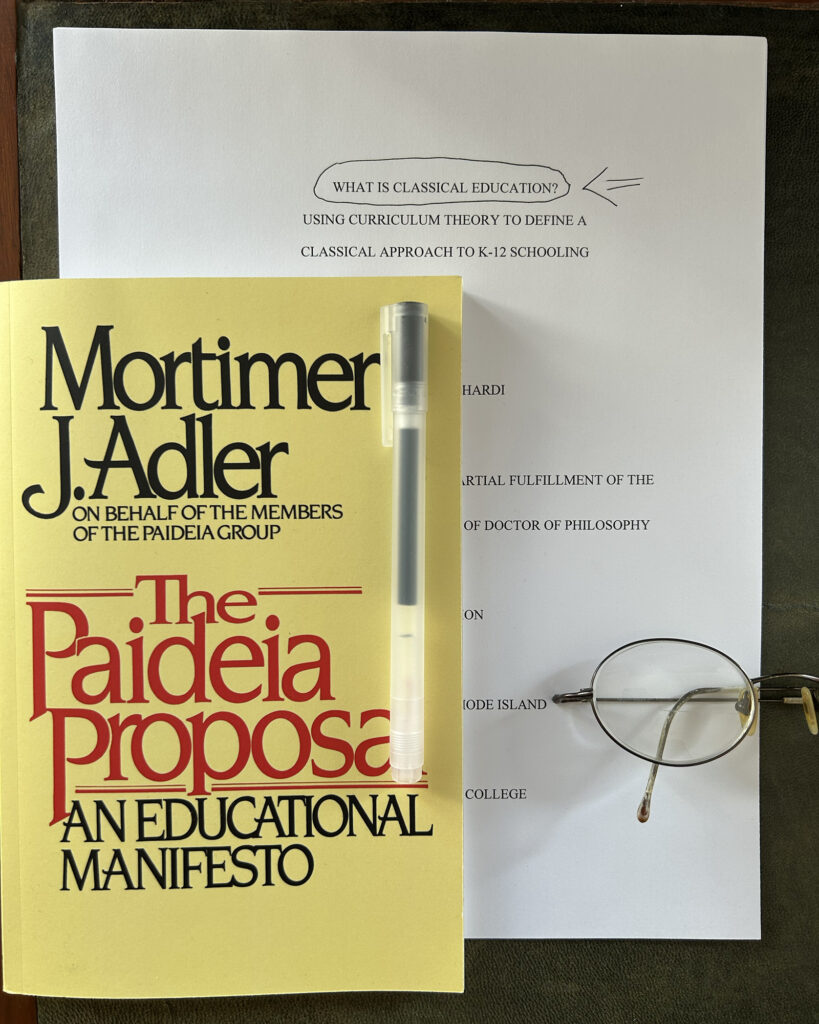
In 1982, Mortimer Adler published his groundbreaking Paideia Proposal, an educational manifesto promoting the “Great Books” of the Western tradition, taught via didactic instruction and Socratic questioning.
According to Gene Veith and Andrew Kern, it’s classical education. In their 2015 book they state that Adler and his colleague Robert Hutchins are the two men “most responsible for the revival of classical education in this century.”
But is Adler’s method really classical education? With a name like Paideia, it certainly sounds like it is. But Dr. Jessica Richardi, in her masterful 2022 paper “What Is Classical Education?” has a different take:
It is this researcher’s opinion that the Paideia Method … is a unique approach to K-12 education and ought to be differentiated from classical approaches which tend to emphasize different forms of knowledge, different methods and goals, and appear less concerned about curricular access.
But who cares whether we call it classical?
One may rightly ask why Paideia’s classification is important, and to whom,” she writes. “In a sense, it seems unjust to force a label upon the product of Mortimer Adler’s life’s work. Having passed in 2001, Adler no longer has the ability to voice his opposition to Paideia’s identification as a classical approach… A fanciful sentiment, perhaps, but it feels as though someone ought to defend Adler’s expressed intent and vision of his own work. Given my current expanded understanding of classical education and Paideia’s relationship to it, I take on that responsibility.
I admire Dr. Richardi for her bold defense of the uniqueness of a method whose originator can no longer speak for himself.
Richardi’s example encourages me to do the same for Charlotte Mason. “The ‘Mason Method,’” she wrote, “involves a whole new scheme of educational thought.” Someone has to say it’s not classical education. I take on that responsibility.
@artmiddlekauff