CMP Review 2025-10-26
I recently saw a poetry contest calling for original compositions with a very specific form: a stanza with six lines, where the rhyme scheme is abcccb and the metrical pattern is iambic as follows:
Lines 1, 3, 4, and 5: tetrameter
Lines 2 and 6: trimeter
This form was used in the single-stanza 1871 “The Centipede’s Dilemma” by Katherine Craster and the six-stanza 1913 “Ah, Are You Digging On My Grave?” by Thomas Hardy. In both poems, the interaction of rhyme and meter creates a sense of anticipation and resolution as each stanza proceeds.
Charlotte Mason’s poem “The Kingdom of God” was written sometime after 1914 and also contains six stanzas. Each stanza follows a form very similar to that employed by Craster and Hardy. Surprisingly, however, the first line in each of Mason’s stanzas is only 7 syllables.
Why this variation? It was surely by design; in the second stanza, she even contracts “proclaimest” to “proclaim’st” to preserve the unusual 7-syllable meter. I personally feel that it has the effect of increasing the sense of anticipation from the opening of each stanza to its end.
The poem is a powerful example of how form can enhance meaning and impact in a poem. The motif of question and answer develops across six stanzas and leads the reader to contemplation and wonder. Experience it yourself here.
@artmiddlekauff
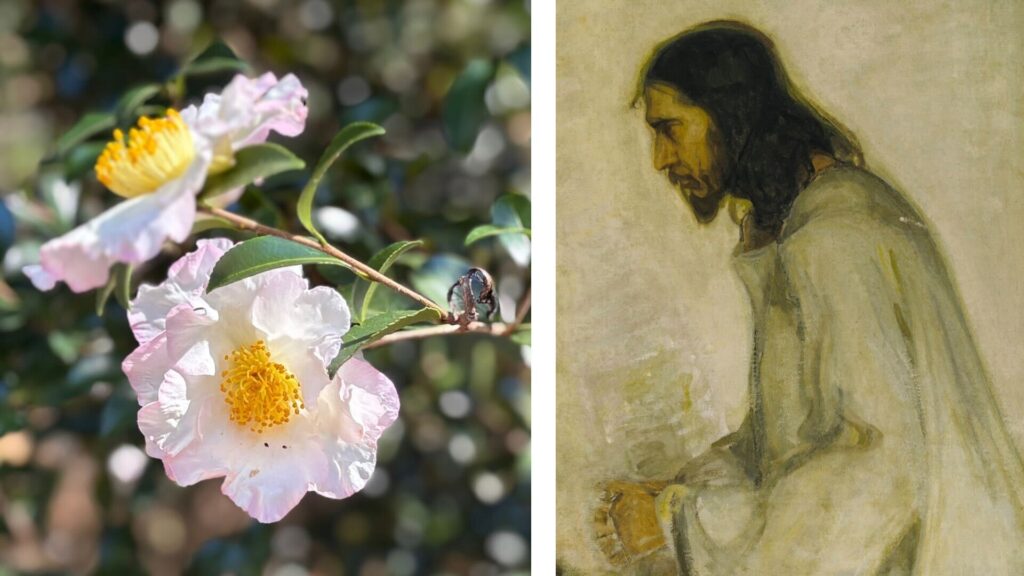
🖼️: The Savior by Henry Ossawa Tanner