CMP Review 2026-04-23
April 23, 2026
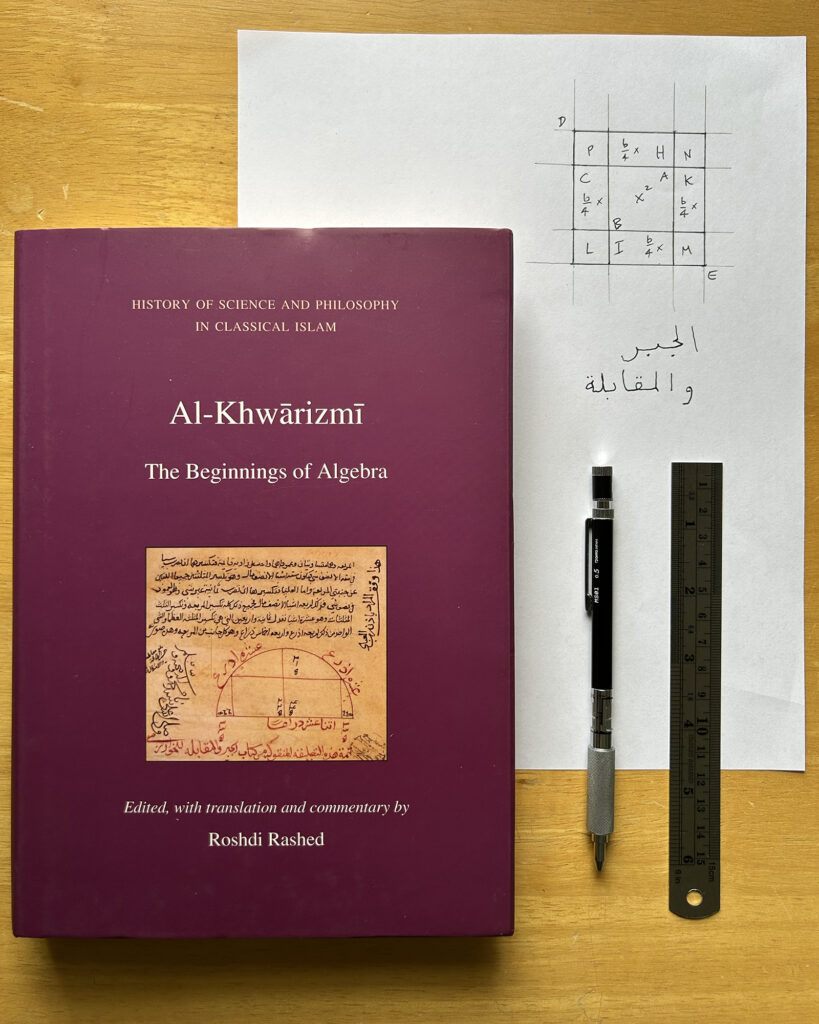
“How interesting Arithmetic and Geometry might be if we gave a short history of their principal theorems,” wrote Charlotte Mason, quoting Alfred Fouillée. “Great theories instead of being lifeless and anonymous abstractions would become living human truths each with its own history like a statue by Michael Angelo or like a painting by Raphael.”
I am currently experiencing what Fouillée describes as being “present at the labours” of a great mathematician. It’s happening as I read Roshdi Rashed’s fascinating Al-Khwārizmī: The Beginnings of Algebra, which includes a fresh translation and transcription the 9th-century book by al-Khwārizmī which gave algebra its name.
Rashed explains just how significant this work was: “Algebra in fact made possible something that until then had been inconceivable: to extend the use of mathematical disciplines from one to another, thus giving rise to new subjects… One major consequence of these applications was a fundamental reorganisation of the structure of mathematics as a whole, whose components could no longer be fitted within the famous quadrivium” (p. vii).
How many mathematicians have prompted “a fundamental reorganisation of the structure of mathematics as a whole”? Not many, and it is exciting to read the story of one. It is not just history, though. It is also math. Al-Khwārizmī justified his algorithm by pointing to a square. And a square might just be the best way to learn it.
@artmiddlekauff