CMP Review 2026-09-22
September 22, 2026
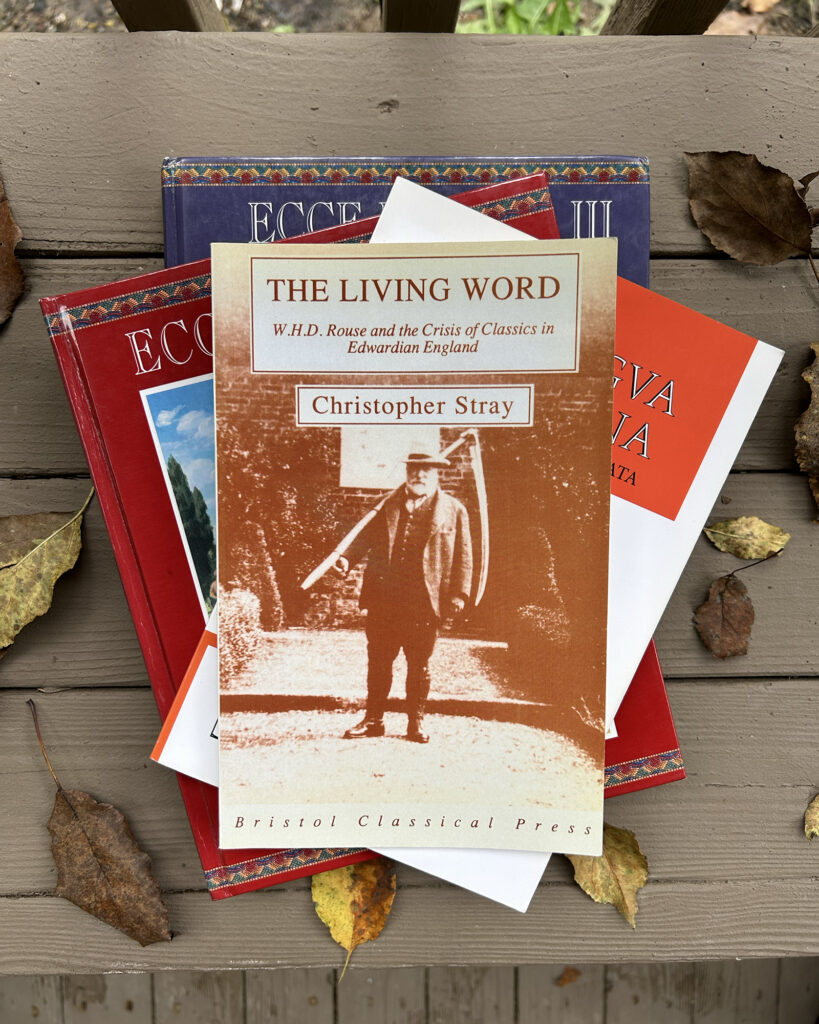
Charlotte Mason’s approach to Latin instruction seems to have evolved over the years. In the 1905 edition of Home Education we read, “Of the teaching of Latin grammar, I think I cannot do better than mention a book for beginners that really answers. Children of eight and nine take to this First Latin Course (Scott and Jones) very kindly, and it is a great thing to begin a study with pleasure.” Scott and Jones first published their somewhat traditional book in 1901 and it was assigned in the PNEU programmes for years.
However, in Mason’s 1925 An Essay Towards a Philosophy of Education, we read, “Latin is taught at the House of Education by means of narration after each section has been thoroughly studied in grammar, syntax and style. The literature studied increases in difficulty as the pupil advances in grammar, etc. Nothing but good Latin is ever narrated, so the pupil acquires style as well as structure. The substance of the passage is usually reproduced with the phraseology and style of the original and both students and children learn what is really Latin and realise that it is a language and not a mere grammar.”
Miss Mason was quoting M. C. Gardner, who wrote that in 1919 she had been “asked by Miss C. M. Mason … to introduce ‘narration’ into the teaching of Latin. It is now an essential, both with the students of the House of Education and with the children in the Parents’ Union School.”
Something seems to have driven Miss Mason to explore a more narration-based approach to Latin instruction. Of course, this might be seen as simply a natural extension of her reliance on narration in the teaching of other subjects. But perhaps other influences were at work. A leading candidate is an event that took place in 1906. At the tenth annual PNEU conference, one of the speakers was W. H. D. Rouse. His story, his address, and his fascinating interaction with the PNEU are presented at the article here.
@artmiddlekauff