The Child Circumcised and Presented in the Temple
[The Saviour of the World] [Volume I] [Book I]
[Poem XIII] Poem XIV [Poem XV]
Circumcision. Presentation. Nunc Dimittis. Anna.
(The Gospel History, Section 11)
And when eight days were fulfilled for circumcising him, his name was called Jesus, which was so called by the angel before he was conceived in the womb.
And when the days of their purification according to the law of Moses were fulfilled, they brought him up to Jerusalem, to present him to the Lord (as it is written in the law of the Lord, Every male that openeth the womb shall be called holy to the Lord), and to offer a sacrifice according to that which is said in the law of the Lord, A pair of turtle-doves, or two young pigeons. And behold, there was a man in Jerusalem, whose name was Simeon; and this man was righteous and devout, looking for the consolation of Israel: and the Holy Spirit was upon him. And it had been revealed unto him by the Holy Spirit, that he should not see death, before he had seen the Lord’s Christ. And he came in the Spirit into the temple: and when the parents brought in the child Jesus, that they might do concerning him after the custom of the law, then he received him into his arms, and blessed God, and said,
Now lettest thou thy servant depart, O Lord,
According to thy word, in peace;
For mine eyes have seen thy salvation,
Which thou hast prepared before the face of all peoples;
A light for revelation to the Gentiles,
And the glory of thy people Israel.
And his father and his mother were marvelling at the things which were spoken concerning him; and Simeon blessed them, and said unto Mary his mother, Behold, this child is set for the falling and rising up of many in Israel; and for a sign which is spoken against; yea and a sword shall pierce through thine own soul; that thoughts out of many hearts may be revealed. And there was one Anna, a prophetess, the daughter of Phanuel, of the tribe of Asher (she was of a great age, having lived with a husband seven years from her virginity, and she had been a widow even for fourscore and four years), which departed not from the temple, worshipping with fastings and supplications night and day. And coming up at that very hour she gave thanks unto God, and spake of him to all them that were looking for the redemption of Jerusalem. And when they had accomplished all things that were according to the law of the Lord, they returned into Galilee, to their own city Nazareth.
And the child grew and waxed strong, filled with wisdom: and the grace of God was upon him.
The Child Circumcised and Presented in the Temple
(The Saviour of the World, Vol I Book I Poem XIV)
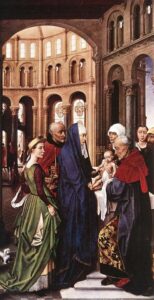
Now when eight days were passed, the Holy Child,
As bids the Law, was circumcised: no friends
Were hospitably called to this poor feast;
But they named Him Jesus, as the angel bade
Ere yet He was conceived in the womb.
Thus height of grace and depth of ignominy
Followed the Holy Child through every stage
Of His yet infant life.
Acquaint with mortal pain,
Obedient, borne,
He suffered in the flesh,
Of glory shorn.
No lust of flesh that frame should mar
Wherein the Son of Man went forth to war.
The days prescribed for purifying past,
Joseph and Mary brought Him to Jerusalem
To give Him to the Lord: for it is writ
That every first-born man-child shall be His:
Would hints of glory gathering round the Child
Take shape of greatness? Mayhap, God might show
If the Babe they carried were indeed His Son.
Poor folk, these brought the poor man’s scanty gift
To symbolise their presentation, doves.
They trod, a peasant pair, the temple courts
Bearing a child; without or circumstance
Or state to show His birth—such group of three
As every day appeared in precincts holy,
None taking heed. This family was observed:
There dwelt in Jerusalem one Simeon,
Who knew: he, righteous and devout, was told
Of the Spirit, he Christ should see in the flesh;
His prayers by day and night, fervent desires
For Israel’s Consolation, should be graced.
So sure was he of this, he watched alway:
No common, usual group might, unaware,
Pass this man, lest so he should miss the Child:
Perceiving he was ready, the Spirit led
Him straight to the temple; and when the parents came,
The simple peasant folk, behold, he knew—
Such is the gift God granteth to His own,
Through signs of everyday they Him discern—
While haughty scribes and priests, collected there,
Gave scarce a glance to these poor country folk;
A hundred such, sure, came there every day!
Now, reverent and meek, approached the priest
With arms outstretched to hold the Holy Child:
Receiving Him, he blessed his God, and said:—
“Now let thy servant, Lord, depart in peace,
Mine eyes have seen the King!
Thy word to me fulfilled, bid my days cease,
Which no more joy can bring:
“For Thy salvation do mine eyes behold!
The very Christ of God,
Before the face of all the world foretold—
The King, whose feet are shod
“With gospel of Thy peace for all mankind!
Not for the Jew alone;
The Gentile also shall salvation find,
For He shall make both one.
“To Gentiles, surely, shall the Christ be shown;
His light shall shine on them:
But this glory is for Israel alone—
The Birth in Bethlehem!”
Out of Zion hath our God appeared
In perfect beauty.
He shall rehearse it when He writeth up the people
That He was born there.
Thus spake the seer, in sacred vision rapt;
Joseph and Mary stood beside, awe-bound,
Marvelling at the great things spoken of Him,
The Child they had brought to the temple: ever more
Glory, greatness, grace, to Him ascribed,
With each new word of God falls on their ear.
And Simeon, looking at the amazèd pair,
Blessed them; and to Mary, His mother, said, “Behold,
This Child shall be for the fall of many great,
The raising up of lowly souls in Israel;
A sign shall He be many shall speak against,
Perceiving the will of God with rebel hearts.
“Yea, and a sword shall pierce through thine own soul!
For He shall suffer, and the smart be thine:
And all the thoughts of men shall be revealed
By the sure witness of the word He speaks.”
Mary heard all, and pondered in her heart.
Another graced to hear the News was Anna,
Daughter of Phanuel, of the tribe of Asser,
A widow of a hundred years or more
Who dwelt in cell within the holy precincts,
And day and night was in the temple courts
Fasting and praying. She, like Simeon,
Waited the Consolation of Israel.
Stirred anew to hope by inner impulse,
And coming at that very hour to Simeon,
She also saw the Christ and blessed her God.
Many who sought the temple knew full well
The aged prophetess, and to them all
She told how God had visited His people.
The happy, gracious Child grew and waxed strong,
Fillèd with wisdom—as a child may be—
Lovely in all His infant ways, nor marred
By rude offence of wilful humankind:
And the grace of God was upon Him.
St. Luke ii. 21-29.
Nunc Dimittis
St. Luke ii. 29-40.
“Out of Zion hath God appeared in perfect beauty.”—Ps. l. 2. (Prayer Book, 1.).
“He shall rehearse it, when He writeth up the people, that He was born there.”— Ps. lxxxvii. 6.
Subscribe: Apple Podcasts | Spotify | Amazon Music | RSS
Commentary by J. R. Dummelow
Lk 2:21. The Circumcision. Although our Lord was sinless, He was subjected to a rite which symbolised the putting off of the sinful lusts of the flesh. Although He was the Son of God, it behoved Him to be made a child of God through the covenant of Abraham. Now first His redeeming blood was shed, and the pain of the Circumcision was a foretaste of Calvary: cp. Mt 3:15 Ro 8:3 Heb 2:17 Gal 4:4. Under the new covenant the sacrament of Holy Baptism (the circumcision made without hands, Col 2:11) has ‘fulfilled,’ and taken the place of circumcision.
Lk 2:22–38. The Purification and Presentation in the Temple. Women after childbirth were unclean, for a boy forty days, for a girl eighty days. They were then bound to present an offering for Purification, viz. a lamb for a burnt offering and a pigeon for a sin offering. Poor women might offer two pigeons, as the mother of Jesus did: see Lv 12:2. A firstborn son was presented to God and redeemed with five shekels of the sanctuary (10 or 12 shillings), Ex 13:2 Nu 8:16 18:15. Neither of these ceremonies necessitated personal attendance of the mother in the Temple. A woman could offer her sacrifices of purification by proxy, and a firstborn son could be presented, and his redemption price paid to a priest anywhere. Joseph and Mary went to the Temple because they were near, and because they loved the house of God.
Lk 2:22. Their purification] i.e. either, (1) the Jews’ purification, or (2) the purification of mother and child. Strictly speaking, however, only the mother (not the child) was ceremonially unclean.
Lk 2:25–35. Simeon and the Nunc Dimittis] Simeon belonged, like Zacharias and Anna, to the class of humble and devout Jews who ‘looked for the redemption of Jerusalem,’ and whose type of piety was very different from that of the scribes: see vv. 37, 38. To such persons the sacrificial system of the Old Covenant and the spiritual teaching of the prophets had been a true preparation for Christ, and consequently God shed abroad among them the gift of prophecy, and revealed to them truths to which the doctors of the Law were blind.
Lk 2:25. Devout] more exactly ‘God-fearing.’ The word is peculiar to St. Luke (Ac 2:5 8:2 22:12). The consolation of Israel] a common expression among the rabbis for the Messianic age. ‘So may I see the consolation’ was a usual form of oath. 26. The Lord’s Christ] the same as ‘the Christ of God’ (9:20), i.e. ‘Him whom God has sent as the Messiah.’
Lk 2:29–32. This beautiful hymn (usually called the ‘Nunc Dimittis’), which has been used in the evening service of the Church since the 4th or 5th century, is in thorough harmony with the spirit of this Gospel. It expressly includes the Gentiles in Christ’s Kingdom, in accordance with the OT. prophecies.
Lk 2:29. The meaning is, ‘My master and owner, now thou givest freedom to thy slave by a peaceful death, according to the prophetic word that thou spakest’ (v. 26). Simeon regards his release from the toils and troubles of life as an enfranchisement from slavery, a change to a state of freedom and rest. In peace means ‘in a state of peace with God.’
Lk 2:30. Thy salvation] is practically personal, meaning the Messiah.
Lk 2:31. All peoples] i.e. all the nations of the earth. 32. A light for revelation to the Gentiles] i.e. the Messiah is the Light of the Gentiles, sent by God to reveal His truth to the heathen world. He is also the glory of the chosen people, because all nations in glorifying the Messiah will glorify the nation from whom the Messiah springs. ‘In those days ten men of all languages of the nations shall take hold of the skirt of him that is a Jew, saying we will go with you, for we have heard that God is with you’ (Zech 8:23).
Lk 2:33. his father and his mother] Since Joseph filled the place of a father to Jesus, he was naturally called his father: cp. v. 27, ‘the parents.’
Lk 2:34, 35. These vv. contain the first hint in the NT. of the sufferings of the Messiah, and of His holy mother.
Lk 2:34. Behold this child, etc.] This child will divide Israel into two opposite camps. Some will reject His claims. To such He will be ‘a stone of stumbling and a rock of offence’ (Isa 8:14), i.e. the occasion of their spiritual ruin. Others will accept His claims. Such He will raise through their faith to a higher spiritual life, which may be rightly called a resurrection (rising again) from death to life.
Lk 2:35. Yea, a sword] This prophecy was fulfilled when Mary saw her Son rejected, condemned, insulted, scourged, and crucified.
That the thoughts] i.e. that the true characters of men (as shown in their reception or rejection of Jesus) may be made manifest.
Lk 2:36–38. Anna the prophetess also recognises Jesus as the Messiah, and speaks of Him as such among those who ‘looked for the redemption of Jerusalem.’ Her manner of life is described in detail, because she is a type of the ‘widows indeed’ of the Christian Church (1 Tim 5:5), who did not marry again, but devoted themselves to works of charity and piety.
Lk 2:36. Prophetess] The title shows that Anna was known as a prophetess before this incident. Other instances of prophetesses are Miriam, Deborah, Hannah, Huldah, and the daughters of Philip. Asher] It is clear that members of other tribes than Judah and Levi returned from the Captivity.
Lk 2:37. If she was married at 12, which is possible in the East, she must have been 103 years old. Departed not] i.e. was unfailing in her attendance. 38. All them that looked, etc.] see on vv. 25–35.
Lk 2:39. Return to Nazareth. St. Luke represents the Holy Family as returning to Nazareth immediately after the Purification, without any allusion to the visit of the Magi, or the flight into Egypt. This seems to indicate that he did not use St. Matthew’s Gospel.
Lk 2:40. Growth and spiritual development of Jesus. The information may have been gained from the mother herself.
Filled with wisdom] lit. ‘becoming full of wisdom’: cp. v. 52, ‘increased in wisdom.’ As Jesus was perfect God and perfect man so He possessed completely the attributes of both natures. As God He knew all things, but as man He ‘waxed strong (in spirit), becoming filled with wisdom,’ and ‘increased in wisdom and stature, and in favour with God and man.’ As an infant He possessed the knowledge proper to an infant; as a boy, that proper to a boy; as a man, that proper to a man; as the anointed Messiah (3:22), that proper to one commissioned to establish the Kingdom of God on earth; and as the ascended and glorified Redeemer, that proper to one who, as man, and not simply as God, rules the entire universe (Mt 28:18). What this means we may not be able to say, but we may rest assured He still feels for man, and understands his needs. Although it was always possible for Him who was God as well as man, to draw, if the needs of His mission required it, upon the inexhaustible stores of His divine knowledge (cp. Jn 1:48), yet it was His usual custom to obtain His information through human channels and from human sources, and, even as a teacher, to use chiefly the ample stores of His supernaturally enlightened human knowledge. This supernatural enlightenment far exceeded both in range and in penetration that granted to the greatest of the prophets—it was the knowledge which was granted to the Incarnate Son for the purpose of communicating to man the Father’s perfect and final revelation; but it was limited in accordance with its object, and did not embrace matters which it was inexpedient for man to know, and therefore for the Incarnate Son to reveal: see on Mk 13:32, and cp. Ac 1:7.