The Marriage in Cana
[The Saviour of the World] [Volume I] [Book III]
[Poem III] Poem IV [Poem V]
Water made Wine.
(The Gospel History, Section 20)
And the third day there was a marriage in Cana of Galilee; and the mother of Jesus was there: and Jesus also was bidden, and his disciples, to the marriage. And when the wine failed, the mother of Jesus saith unto him, They have no wine. And Jesus saith unto her, Woman, what have I to do with thee? mine hour is not yet come. His mother saith unto the servants, Whatsoever he saith unto you, do it. Now there were six waterpots of stone set there after the Jews’ manner of purifying, containing two or three firkins apiece. Jesus saith unto them, Fill the waterpots with water. And they filled them up to the brim. And he saith unto them, Draw out now, and bear unto the ruler of the feast. And they bare it. And when the ruler of the feast tasted the water now become wine, and knew not whence it was (but the servants which had drawn the water knew), the ruler of the feast calleth the bridegroom, and saith unto him, Every man setteth on first the good wine; and when men have drunk freely, then that which is worse: thou hast kept the good wine until now. This beginning of his signs did Jesus in Cana of Galilee, and manifested his glory; and his disciples believed on him.
The Marriage in Cana
(The Saviour of the World, Vol I Book III Poem IV)
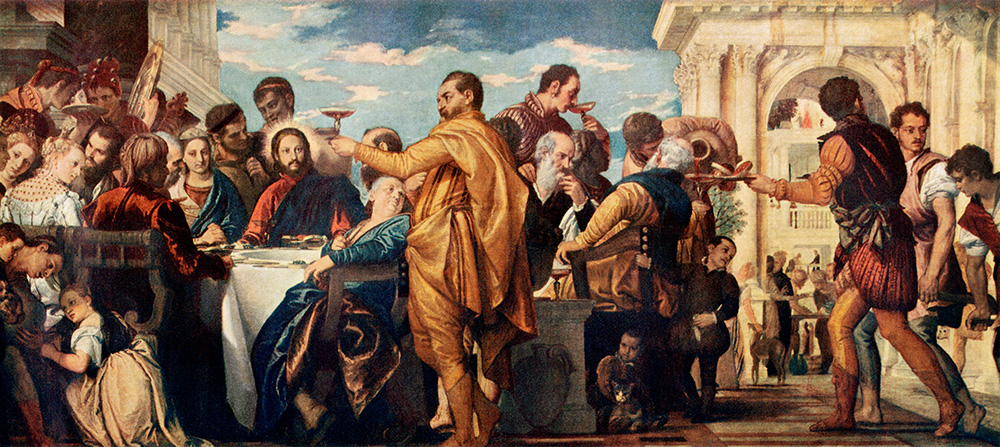
In Cana was a marriage made;
The bridegroom to the wedding bade
Jesus, His mother, and the five.
We learn not how the guests arrive,
Nor who in the high places sate,
Nor if five virgins came too late:
Nor know we that a single one
Had not a wedding garment on.
We know that Christ was bidden, went,
With royal courtesy of consent:
And every wedding shines in grace
Of that to which He lent His face!
Perhaps for days the wedding feast
Had progressed; all, the first and least,
Were graced as guests with meats and wine,
Observance, service, every sign
That in the hospitable East
Is due from him who makes a feast.
Mary, the mother, seemed at home;
Was it, perhaps, a kinsman, whom
To honour all the guests had come?
Troubled she learns, “The wine has failed!”
Dismay in all the house prevailed:
But Mary, “What if now the hour
When He shall manifest His power?”
“They have no wine,” she told her Son,
Nor ventured what she would have done.
The moment to our Lord seemed meet
To teach for aye His mother sweet—
The days of His subjection o’er—
She might not try to rule Him more:
For no son is it good to be
Guided in his maturity;
And for men’s sake Christ spake a word,
Sure not austere when first ’twas heard,—
So never more should grievous thought,
To Virgin Mother’s breast be brought—
“What have I now to do with Thee?”
Thy Son, a man, must needs go free
From mother’s importunity!
And Mary understood the word:
Nor vexed, nor sore, all undeterred,
She bade the men (as in command)
Receive their orders at His hand.
“Do whatsoever He shall say!”
Alert, they waited to obey.
Six waterpots of stone were set,
Prodigious, so should be no let
To goodly custom of the Jews,
Their hands, their cups, oft to suffuse
With water while the feast progressed.
His time now come to manifest
By first great sign His power to men—
Ages and moments in His ken
Are all as one, but every deed
Shall, in its time, from Him proceed;
Who hasteth not nor ever rests
Times, by occasion, His behests.—
His time now come to show to man
Act of creation once again,
Show year-long processes contract
To compass of an instant’s act,
Ripe vintage of the grape flow forth
Without, or seed, or sun, or earth,
And water leave the jars as wine,
With Life informed, of Life the sign.—
“Fill ye the waterpots,” He bade;
The eager servants quick obeyed
And filled them to the very brim.
“And now draw out and bear to him
Who rules the feast.”—With curious eye
He spake to bridegroom standing by,—
“Most men at first produce their best;
When men have drunk, they serve the rest,
The weaker, poorer sort; but thou
Hast kept the best wine until now!”
The bridegroom heard as pleasant jest,
Not knowing that indeed the best
Wine ever quaffed at wedding feast
Was served that day to last and least.
Nor knew the ruler the strange tale
Of what had happ’d lest wine should fail;
Only the servants knew, and they,
For bridegroom’s honour, would not say.
As on accession of a king
His servants free libations bring,—
So these, unknowing, graced the Unknown,
The King that day come to His own!
“But to what purpose was this waste?”
The thrifty soul cries in his haste;
“For royal banquet were excuse,
But tuns of wine here—for abuse!”
Later, a hundred years, one day
An honoured guest had come to stay:
“You like the wine? You have not met
Vintage so delicate as yet?
Dearer than heart’s blood is each drop
To us of this household! Nay, stop
And hear the tale: a wedding here,
My great-great-grandsire’s nuptial cheer,
Was graced within these very walls
By presence of the Lord! That calls
The blood to your cheek!”—Then all the tale
He told of how the wine did fail,
How Christ turned water into wine,
More costly, but not more divine
In origin than water is;
And how this wine, a cup of bliss,
Was given to such as love the Lord;
Was offered, too, to those who heard
For the first time of Christ, His power,
And served and loved Him from that hour.
“Cup of communion, do we call
This cup which moves Christ’s life in all.”
(Who knows but some such simple tale
Our royal Master’s lavish vale
Might justify to careful soul
Who nicely calculates his dole?)
St. John ii. 1-11
“But to what purpose was this waste?”
The sign of the water turned into wine.
Subscribe: Apple Podcasts | Spotify | Amazon Music | RSS
Commentary by J. R. Dummelow
Jn 2:1–11. The marriage at Cana. This miracle is not recorded by the synoptists because it occurred before the beginning of the ministry proper. St. John records it, because, spiritually interpreted, it forms a suitable introduction to our Lord’s ministerial work. It teaches, (1) the superiority of the Gospel to the Law. Christ changes the water of Judaism into the good wine of the Gospel. This is not a fanciful interpretation, but an entirely natural one, if it be granted (as is abundantly shown in the Intro.) that the ancients were right in regarding this Gospel as a ‘spiritual’ or allegorical one. (2) Being a physical or creative miracle, it manifests Christ as the Lord of matter as well as of spirit. (3) It sanctifies marriage, and gives Christ’s approval to innocent mirth and gladness. (4) It reveals God’s goodness and overwhelming bounty. In recording it, St. John doubtless had in view the Gnostic false teachers, who regarded matter as evil, and practised a rigid asceticism, rejecting all bodily pleasures, and abstaining from flesh and wine, and even from marriage. Such teaching was very prevalent in Ephesus, where this Gospel was written (see 1 Tim 4:1–6), and tradition tells us that St. John vehemently opposed it.
Jn 2:1. The third day] It was a three-days’ journey from Judæa to Galilee. Cana] now Kana-el-Jelil, a village 9 m. NW. of Nazareth, called ‘of Galilee’ to distinguish it from Cana (Kanah) in Asher (Josh 19:28). 3. They have no wine] The deficiency happened towards the close of the festivities, which usually lasted seven or fourteen days (Jg 14:15 Tob 9:19). It was perhaps caused by the presence of so many (five or six) of the disciples of Jesus, and hence our Lord had a natural motive for working the miracle. 4. Woman] A very gentle rebuke, but still a rebuke. Now that His ministry has actually begun, not even His mother may presume to suggest or control His course of action: cp. Mt 12:46 Lk 11:27. ‘Woman,’ or, rather, ‘Lady,’ is in Greek a title of respect, used even in addressing queens.
Mine hour (i.e. for putting forth My miraculous power) is not yet come] Yet it came a few minutes later, when the Father, by an inward revelation, had manifested His will to Jesus. ‘Hour,’ in the sense of ‘appointed time,’ is common in this Gospel (7:30 8:20 12:23, 27 13:1 17:1). 6. Purifying] Washing the hands before dinner (Lk 11:38) is meant: cp. Mk 7:3, and see the full notes on Mt 15:1–20.
Firkins] Gk. metretes, about 9 gallons.
Jn 2:9. Ruler] an honoured guest, who presided at the entertainment. 10. drunk freely] The expression is proverbial, and need not be literally interpreted of the present company.
Jn 2:11. Beginning of signs] Clearly Christ wrought no miracles in His childhood, as the Apocryphal Gospels assert. St. John calls our Lord’s miracles ‘signs,’ because they indicate something beyond themselves. They are no mere marvels, but reveal God’s character, Christ’s divine nature, and the mysteries of the gospel dispensation. All the miracles in this Gospel are also parables: see Intro. Manifested] To ‘manifest’ is to display something which before was hidden; here, the glory of His Messiahship, faith in which, already begun among the disciples (1:41), was confirmed by this miracle.