Baptism of Jesus
[The Saviour of the World] [Volume I] [Book II]
[Poem IV] Poem V [Poem VI]
Baptism of Jesus.
(The Gospel History, Section 16)
And it came to pass in those days, when all the people were baptized, that Jesus also came from Nazareth of Galilee to the Jordan unto John to be baptized of him. But John would have hindered him, saying, I have need to be baptized of thee, and comest thou to me? But Jesus answering saith unto him, Suffer it now: for thus it becometh us to fulfil all righteousness. Then he suffered him. And Jesus when he was baptized went up straightway out of the water and was praying: and lo, the heavens were opened unto him, and he saw the Spirit of God descending in a bodily form as a dove and coming upon him; and lo, a voice came out of the heavens, saying, This is my beloved Son; in whom I am well pleased.
Baptism of Jesus
(The Saviour of the World, Vol I Book II Poem V)
Now, in those days when all men were baptized,
It came to pass that Jesus journeyed forth
From Nazareth of Galilee to the Jordan
Unto John to be baptized of him. But John,
To whom man’s face was as an open book,
Saw coming, One, the like of whom before
His eyes had not beheld; of countenance
Unsullied from the womb by passing thought
Unworthy, aspect benign and gracious—
So might all living souls and things of earth
Hang cheerful on His glad beneficence:—
Impressions like to these, but more than these,
His quick sense caught; as the august Presence,
With never following or sign of state,
Drew near, the prophet quailed before the light
Of Godhead on His brow, not knowing it.
John would have hindered Him from being baptized—
“It is I have need to be baptized of Thee,
And comest Thou to me?” Jesus, regarding
His forerunner with sweet look (who knew Him not
Save as he had eyes and saw), said, “Suffer it now;
Thus it becometh us all righteousness
To fulfil. That which is good for all, is good
Likewise for Me, for Mine, the life of all.”
Then he suffered Him. Jesus, being baptized,
Went straightway up from the water, and knelt and prayed.
And, behold, the heavens opened, and John saw
The Spirit of God descending, like a dove
In bodily form, and coming upon Him
(John knew the sign which answered all his thought),
And, lo, a Voice out of the heavens spake,
“This is My Son beloved, who pleaseth Me.”
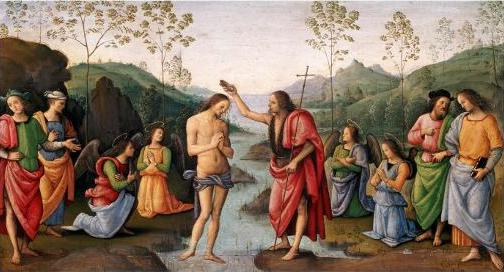
St. Matthew iii. 13-17.
St. Mark i. 9-11.
St. Luke iii. 21, 22.
Subscribe: Apple Podcasts | Spotify | Amazon Music | RSS
Commentary by J. R. Dummelow
Mt 3:13–17. Baptism of Jesus. The Baptism of Jesus has more than one aspect and significance. To John it was with its miraculous accompaniments a sign that Jesus was the promised Messiah and the Son of God (Jn 1:32–34). To Israel it was ‘the showing to the people’ of the promised monarch, and His consecration by the unction of the Holy Spirit to the threefold office of prophet, priest, and king. To the Christian Church it is the type and first example of all true baptism—the baptism, that is, of water and the Spirit. So far all is clear. But when we come to speak of its significance to Jesus Himself we are in a region of mystery, and both prudence and reverence teach us not to dogmatise. Yet we may venture to say this, that the vision at the Baptism was intended primarily for Jesus Himself, and neither for John nor for the multitudes who were present. It was Jesus to whom the heavens were opened, Jesus who saw the Spirit descending as a dove, and Jesus to whom the momentous words were spoken, ‘This is My beloved Son, in whom I am well pleased.’ This is expressly testified by St. Matthew and St. Mark, and is not contradicted by St. Luke and St. John, although the last states what St. Luke perhaps also implies in the words ‘in a bodily form,’ that the vision was also intended for the Baptist. If we take the most natural and obvious interpretation of the incident, we shall hold that our Lord’s baptism marked the point in His career when there first awoke in Him the complete consciousness of His divine sonship, and of all the tremendous consequences which this unique relationship to God and man involved. There must have been a time when this consciousness first became fully explicit. He cannot have had it in unconscious infancy, or as a young child. Even as a boy (we are speaking, of course, of His human knowledge) He cannot have possessed it complete. He grew in knowledge of things human and divine (Lk 2:40–52), and one of the things in knowledge of which He grew was the awful mystery of His own Divine-Human Personality. He must, of course, have been always conscious, after attaining the use of reason, of the difference between Himself and other men, of the unique character of His communion with God, and of the greatness of the mission which lay before Him, but He need not have known all. It is possible that full self-knowledge might have hindered rather than helped Him during the thirty years of obscurity which preceded His public ministry. But however that may be, before the ministry began the veil that concealed the mystery of His nature was drawn aside by an inward revelation, and soon the outward testimony of miracles confirmed what the inward voice had declared.
Mt 3:14. I have need] not inconsistent with Jn 1:33 (‘I knew him not’). As Jesus approaches, a prophetic presentiment passes through the mind of John that this is the Messiah. The descent of the Spirit makes it a certainty. It is possible, even likely, that as John and Jesus were cousins, they were already acquainted, although John ‘knew him not’ as the Messiah. As John’s baptism was unto remission of sins, it seemed to him strange that Jesus should have consented to such a baptism. But, though sinless, Jesus came to identify himself with sinners. He would be ‘under the law that he might redeem those that were under the law’ (Gal 4:4, 5).
Mt 3:15. To fulfil all righteousness] i.e. to fulfil all the ordinances of the old covenant among which our Lord reckoned John’s baptism.
Mt 3:16, 17. One of the leading Trinitarian passages in the NT. The voice of the Father is heard proclaiming the essential divinity of the Son, and upon the Son, as He rises from the baptismal waters, the Holy Ghost, the living bond of love and unity in the Godhead, descends. The appearance of the Holy Ghost in the form of a dove was a symbolical vision, and, as spiritual things are spiritually discerned, the vision was probably seen only by our Lord and the Baptist. The dove is a type of the Spirit, because of its innocence, gentleness, and affection; cp. 10:16, ‘Be ye therefore wise as serpents, and harmless as doves.’ The voice from heaven may be paralleled by the voice at Sinai (Ex 20), to Nebuchadnezzar (Dan 4:31), at the Transfiguration (Mt 17:5), before the Passion (Jn 12:28), to St. Paul (Ac 9:4), and to St. Peter (Ac 11:7). The idea that a revelation might be communicated by a supernatural voice, was familiar to the Jews of our Lord’s time. The rabbis taught that after the cessation of prophecy, God continued to make revelations to His people by means of the Bath-kol, or heavenly voice. At Jericho, for example, the Bath-kol declared the Rabbi Hillel to be worthy to have the Spirit of God abide upon him, and at Jamnia decided the dispute between the schools of Hillel and Shammai in favour of the former.
Mt 3:16. And he saw] i.e. Jesus saw, though John saw it also.
Mt 3:17. This is] This represents the form in which the Baptist heard the words. ‘Thou art’ (Mk, Lk) represent the form in which Jesus heard them. My beloved Son] cp. 17:5. The highest sense is to be given to these words. The Father bears witness, not only to Christ’s Messiahship, but to His eternal and divine Sonship, in virtue of which He is from all eternity ‘in the bosom of the Father,’ loving and beloved. In whom I am well pleased] cp. Isa 42:1 Mt 12:18. Lest the Baptism of Christ should be thought to indicate that He was a sinner like ourselves, the Father was pleased to pronounce Him absolutely sinless. The tense of the Gk. is difficult. The Revisers (also Plummer) regard it as a timeless aorist. But it may be an ordinary historical aorist, and thus point to Christ’s preëxistence—‘in whom I was well pleased,’ viz. before the Incarnation and before the creation of the world. The words are also a message full of grace to mankind. As the Son is ever well pleasing and acceptable to the Father, so also are all those who are found in Him.