Flight into Egypt
[The Saviour of the World] [Volume I] [Book I]
[Poem XV] Poem XVI [Poem XVII]
Flight into Egypt.
(The Gospel History, Section 13)
Now when they were departed, behold, an angel of the Lord appeareth to Joseph in a dream, saying, Arise and take the young child and his mother, and flee into Egypt, and be thou there until I tell thee: for Herod will seek the young child to destroy him. And he arose and took the young child and his mother by night, and departed into Egypt; and was there until the death of Herod: that it might be fulfilled which was spoken by the Lord through the prophet, saying, Out of Egypt did I call my son. Then Herod, when he saw that he was mocked of the wise men, was exceeding wroth, and sent forth, and slew all the male children that were in Bethlehem, and in all the borders thereof, from two years old and under, according to the time which he had carefully learned of the wise men.
Flight into Egypt
(The Saviour of the World, Vol I Book I Poem XVI)
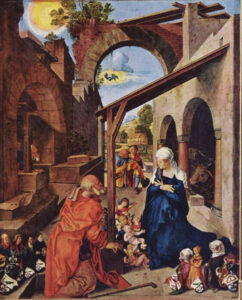
The Holy Family reposed that night;
But th’ angel spoke to Joseph in a dream—
“Flee,” the august mandate, “for Herod seeks
The young Child to destroy Him. Go thou hence,
Take Child and mother into Egypt; there
Abide till I shall tell thee.” And he arose,
Straight, as man under orders; waked the mother,
Who, fearful, heard the dream, and snatched the Child
As from peril of death, quick wrapping Him
With mother love for journey. They soon gat
The small gear they must carry, and went forth—
Wanderers and homeless in the night: but, rich
Beyond who dwelt in palaces, they bore
The Saviour of His people Israel.
When poor folk journey, distress attends their way:
We fain would know all pains that Jesus bore,
Tell every pang that magnifies the more
His grace to usward! Otherwise, the mind
Of the Spirit:—“there till the death of Herod”—
This, all the word vouchsafed to love, hungered
For crumb of knowledge of that Blessed Life.
And, “out of Egypt have I called My Son,”
Their warrant for returning—prophet’s word.
Of toilsome travel, perils by the way,
Of strangers’ lot in Egypt, neglect and want;
Of the first infant graces of the Child—
Concerning these, no word for loving hearts!
Is’t true, that painter’s vision—how a troop
Of buoyant children upon rainbow wings
Gamboll’d with infant glee round Infant King?—
Those innocent martyrs first to die for Christ!
True? Who can tell! But this, at least, we know—
Their young men shall see visions; old, dream dreams:
And sweet Madonna-pictures, gracing the world,
Fair visions of the Mother and the Child,
With pomegranate, or apple, or with book,
’Mid bowering roses or fair lilies pure,
With infant playmate, or wedding a sweet saint—
All these are true; for, what the sum of them,
But Holy Child on lap of mother pure?—
Such sight the painters saw at many a door.
St. Matthew ii. 13–16.
Subscribe: Apple Podcasts | Spotify | Amazon Music | RSS
Commentary by J. R. Dummelow
Mt 2:13–15. Flight into Egypt (peculiar to St. Matthew). Egypt was the only place of refuge easily reached from Bethlehem. It was outside the dominions of Herod, under Roman government, and contained a population of at least a million Jews, who were more wealthy and enlightened than those of Palestine. It was notorious for its superstition and gross idolatry, and legend has represented the idols of Egypt as falling flat on their faces before the Holy Child.
Mt 2:15. Until the death of Herod] Herod died probably 4 b.c., possibly 3 b.c., so that the sojourn in Egypt was short, perhaps only a few months.
Out of Egypt] Hos 11:1. It is impossible that the flight into Egypt was invented to fulfil this prophecy, which in Hosea is simply an historical allusion to the deliverance of Israel from Egypt. My son] in the original passage is the nation, not the Messiah, and so the LXX understood it. St. Matthew, however, saw in the history of Israel a typical foreshadowing of the life of our Lord, and so, in accordance with rabbinical methods of interpretation, applied it to Jesus. Here St. Matthew quotes directly from the Heb. The LXX has ‘Out of Egypt did I call his (Israel’s) children.’