Meeting with Elizabeth
[The Saviour of the World] [Volume I] [Book I]
[Poem VII] Poem VIII [Poem IX]
The Annunciation. Visit to Elisabeth. Magnificat.
(The Gospel History, Section 6)
And Mary arose in these days and went into the hill country with haste, into a city of Judah; and entered into the house of Zacharias and saluted Elisabeth. And it came to pass, when Elisabeth heard the salutation of Mary, the babe leaped in her womb; and Elisabeth was filled with the Holy Ghost; and she lifted up her voice with a loud cry, and said, Blessed art thou among women, and blessed is the fruit of thy womb. And whence is this to me, that the mother of my Lord should come unto me? For behold, when the voice of thy salutation came into mine ears, the babe leaped in my womb for joy. And blessed is she that believed; for there shall be a fulfilment of the things which have been spoken to her from the Lord. And Mary said,
My soul doth magnify the Lord,
And my spirit hath rejoiced in God my Saviour.
For he hath looked upon the low estate of his handmaiden:
For behold, from henceforth all generations shall call me blessed.
For he that is mighty hath done to me great things;
And holy is his name.
And his mercy is unto generations and generations
On them that fear him.
He hath shewed strength with his arm;
He hath scattered the proud in the imagination of their heart.
He hath put down princes from their thrones,
And hath exalted them of low degree.
The hungry he hath filled with good things;
And the rich he hath sent empty away.
He hath holpen Israel his servant,
That he might remember mercy
(As he spake unto our fathers)
Toward Abraham and his seed for ever.
And Mary abode with her about three months, and returned unto her house.
Meeting with Elizabeth
(The Saviour of the World, Vol I Book I Poem VIII)
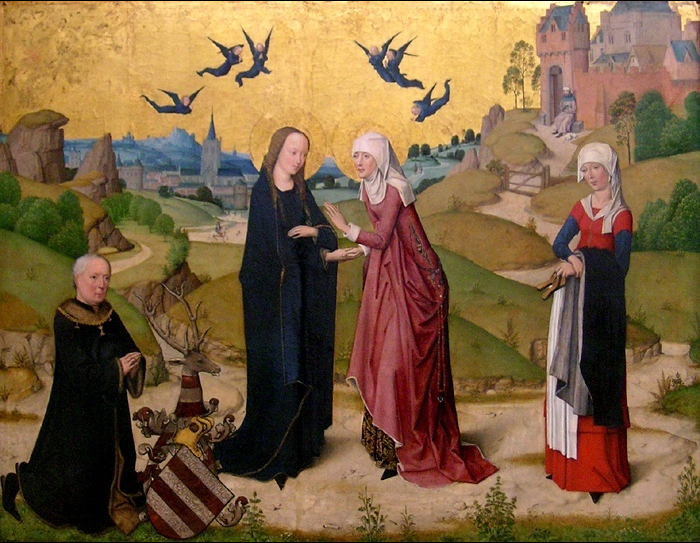
Much troubled was the Maid—full of high hope
And diffident fear: nor might she tell her mind
To kin or neighbour, least of all, to him,
Her betrothed husband: so, with bold resolve,
She would go forth to seek among the hills
Of southward Judah for Elizabeth:
The friendly seraph, sure, had meant that she
Might ease her bosom in her kinswoman’s arms!
Little she recked of distance, lonely ways,
Of days of travel, footsore and distressed,
And nights of little ease: Mary made slow way
To the hill-city, Hebron, where she dwelt
To reach whom all this travail. Entering the house
Of Zacharias, with sisterly salute,
Elizabeth she greeted.
At her word,
Tumult of welcome whelmèd the poor Maid,
Lonely and travel-worn: when Elizabeth heard
Her cousin’s salutation, in her womb
Up-leaped the babe: and, full of the Holy Ghost,
With a loud cry she lifted up her voice:—
“Thou blessèd amongst women, whence is this,
That the Mother of my Lord should come to me?
No sooner had the babe I bear thy voice
Heard, me saluting, than he leaped for joy!”
Then, fill’d with the Spirit of God, she blessed the Maid:—
“To her who could believe, shall be fulfilled
The whole of God’s high counsels.” And Mary said:—
“My soul rejoiceth in the Lord,
My spirit triumphs in His word;
He looked upon my low estate,
And, looking, made His handmaid great:
To God, my Saviour, be the praise,
Who lowliest men doth highest raise!
“Henceforth the generations shall
Name me for Blessèd, one and all;
He that is mighty hath to me
Done great things, low though my degree:
His mercy is for ever sure
While tribes and nations shall endure!
“Holy His name, and full of grace
To them that fear, and seek His face:
His arm with ready strength is found
To cast the high ones to the ground,
Scatter the proud, the meek upraise,
And nourish all their sheltered days:
“The rich go empty, and the poor,
Filled with good things, shall leave His door;
Princes from thrones He putteth down,
To raise those meek who be His own:
To His servant Israel brought He aid,
The promise He of old hath made;—
“That mercy should remembered be,
That Abraham his race should see
Countless as sand on the seashore,
Blessed by their God for evermore!
The promise that hath been of old
To Abraham and his sons foretold,
To kings and prophets dimly shown—
His secret—now, He maketh known:
The promised Seed is come, and I,
Poor Maid, by God, am set on high!”
St. Luke i. 39-56
Subscribe: Apple Podcasts | Spotify | Amazon Music | RSS
Commentary by J. R. Dummelow
Lk 1:39–56. Mary’s visit to Elisabeth. The Magnificat. This beautiful narrative must be derived from Mary herself, probably directly. It is told as vividly and minutely after a lapse of half-a-century as if it were an event of yesterday. Clearly it was one of those things which the Virgin mother kept and pondered in her heart.
Lk 1:39. Into a city of Judah] or, ‘into a city called Judah’ (i.e. possibly Juttah, a priestly city near Hebron).
Lk 1:41. The babe leaped] The Jews believed that children were intelligent before birth: cp. Gn 25:22. 42. Blessed art thou among women] A Hebraism for ‘Thou art the most blessed of all women’: see on v. 48.
Lk 1:43. The mother of my Lord] The aged Elisabeth acknowledges that the young maiden is greater and more highly favoured than she, because she is ‘the mother of my Lord,’ i.e. of the Messiah. 44. See on v. 41.
Lk 1:46–55. The Magnificat. This glorious song of praise, which has been used in the services of the Church from early times, tells us more than anything else in the NT. of the character of our Lord’s mother, and of her spiritual fitness for her exalted destiny. She was one who diligently searched the Scriptures, and was able in spite of her youth to enter into their deepest spiritual meaning. Not that she had risen as yet beyond the standpoint of Judaism. She still regarded the coming of the Kingdom as an overthrow of Herod’s dynasty and a restoration of Jewish nationalism (vv. 52, 54). But her thoughts were fixed on its ethical character. It meant to her the setting up of the ideal of humility, gentleness, and charity, in place of the pride of temporal greatness, a thought which her Son carried further when He said, ‘Except ye be converted, and become as little children, ye shall not enter into the kingdom of heaven.’ In the Magnificat Mary appears as a prophetess, like Hannah, whom she closely imitates, but greatly excels in spiritual elevation: see 1 S 2:1. The genuineness of the Magnificat is manifest from its thoroughly Jewish character. It contains no trace of definitely Christian ideas. These may be read into it, and were intended by the Holy Spirit to be ultimately read into it, but they are not there in such a form as to be apprehended by those who are not already Christians. The Magnificat is conveniently divided into two parts: (1) vv. 46–49, (2) vv. 50–55. The first part is personal in character, expressing the exultant praise of the holy mother for the signal favour which God has shown her, and foretelling that all future generations will call her blessed. The second part sets forth the character of the Kingdom as a moral revolution, and a reversal of all existing standards of goodness and greatness.
Lk 1:46. In the Gospels (not in the Pauline Epistles) ‘soul’ and ‘spirit’ are synonymous.
Lk 1:47. In God my Saviour] In Mary’s idea of ‘salvation’ was doubtless included deliverance from foreign power as well as spiritual deliverance. ‘God my Saviour’ is, of course, in accordance with OT. ideas, God the Father. Not till much later did she come to regard her Son in this aspect. 48. The low estate] cp. 1 S 1:11. Mary, though descended from David, was in humble circumstances.
All generations shall call me blessed] Prophetically spoken. She has become the pattern of womanhood and motherhood to the whole Christian world, and her song has been enshrined in the Liturgy of every Christian Church. Reverence for our Lord’s mother, even in its abuses, has not been without its elevating effect on humanity. ‘It is remarkable,’ says a judicious writer, ‘that one of whom we know nothing except her gentleness and her sorrow, should have exercised a magnetic power upon the world incomparably greater than was exercised by the most majestic female patriots of Paganism. Whatever may be thought of its theological propriety, there can be little doubt that the Catholic reverence for the Virgin has done much to elevate and purify the ideal of woman, and to soften the manners of men. It supplied in a great measure the redeeming and ennobling element in that strange amalgam of religious, licentious, and military feeling which was formed round women in the age of chivalry, and which no succeeding change of habit or belief has wholly destroyed’ (Lecky).
Lk 1:49. Cp. Ps 111:9. 50. Cp. Ps 103:17. 51. Cp. Ps 89:10. With prophetic certainty Mary regards the putting down of pride, and the establishment of meekness as already achieved.
Lk 1:52. Cp. Job 5:11 12:19 1 S 2:7. Princes] include Herod and his dynasty, but the main idea is that a kingdom based on humility and love has entered into the world, more powerful than all earthly kingdoms, and destined to revolutionise them. 53. Cp. Pss 107:9 34:10 1 S 2:5. In true OT. style spiritual and temporal blessings are conceived of as united in the Messianic age. The temporal needs of the poor and lowly are to be cared for and their wrongs redressed. All things needful both for their souls and bodies will be bountifully supplied. 54. Cp. Ps 98:3. 55. Cp. Mic 7:20. The national feeling is pronounced. The Gentiles are not mentioned, except indirectly in the allusion to the promise to Abraham. 56. Joseph’s discovery of Mary’s condition (Mt 1:18) must have been subsequent to her return to Nazareth.