Swedish Drill in the 21st Century
G. K. Chesterton said:
Fairy tales do not give the child his first idea of bogey. What fairy tales give the child is his first clear idea of the possible defeat of bogey. The baby has known the dragon intimately ever since he had an imagination. What the fairy tale provides for him is a St. George to kill the dragon.[1]
You may have heard this quote before, or a popular paraphrase of it, and loved it as much as I do. It refers to courage: a trait needed by us all as we pursue the course of this thing called life. Mason saw the value of fairy tales and the courage that they inevitably produced in our children, which is one of the many reasons why her programs were so rich in literature. But there’s another aspect of this quote worth analyzation outside of character traits produced by the written word: the physical side.
We often wax eloquent over the benefits of a Charlotte Mason education upon a child’s mind and soul, but what about their bodies? After all, are we not whole persons, consisting of more than just a mind and soul? And would it not be neglectful of the education of a born person to give them a feast of ideas regarding literature, mathematics, science, the Father in heaven, and the arts, but neglect the very vessel that will house them in the pursuits of these things? Have we not seen many geniuses throughout history whose lives were cut short due to physical neglect or abuse, leaving us only to lament: “If they had had more time, I wonder what they would have accomplished!”
Thankfully, Mason’s pedagogy encompasses the entire, whole person: mind, spirit, and body. After all, what use is courage to fight the dragon, if one has not the strength to lift a sword?
When we analyze Mason’s programs regarding physical education, we see a variety of activities just as rich in diversity as her history and science — they’re full of skills, games, marching, dance and so much more. But the proverbial “elephant in the room” on the list stands as a banner of discomfort to many of us: Swedish Drill.
You may have seen Swedish Drill and immediately thought, “I have enough on my plate, we’ll just go play outside instead.” Or, “I don’t have time to add another subject to our school day, after all, my kids are on the baseball team—isn’t it the same thing in the end?”
The beauty of Mason’s feast is that it indeed had lots of play time and yes, even games similar to baseball; however, again and again we see that her programs not only listed Swedish Drill as an option, it was THE leading aspect in the subject of physical movement. While games appear as a regular part of the lessons in a variety that would challenge the plethora of potato chips on the grocery aisle, they still do not appear with the regularity in which this form of drill appears. In forms I through IV (grades 1st–9th) drill appears every other day, but this increases to daily in the rest of high school.[2] And although there were varying forms of drill within the programs, the undisputed champion of them all in appearance is specifically Swedish Drill. Miss Mason herself states in Volume 1 that “For physical training nothing is so good as Ling’s Swedish Drill…”[3] So yes, Mason seems to have believed that Swedish Drill offered something that games and outdoor play did not. So what was it?
To understand this concept, we must look closer on what Swedish Drill is. From the outside looking in, it appears to be a glorified game of Simon Says: the teacher gives a movement command and the child executes what has been assigned. However, it’s actually much more complex than that. Swedish Drill is a carefully designed physical program that uses “tables” as its guide during each lesson, with each table following a specific pattern. The lesson appears as a list of movements that have been assigned on the left side and the script for what the teacher says to the student on the right. If you look at the table below, you’ll see that there is very little script listed. This is simply because teachers of Swedish Drill would have gone through special training for this program and would have had the command words for these movements memorized. But there’s more to what you’re looking at, so let’s dive deeper into the assigned pattern of a Swedish Drill Table.
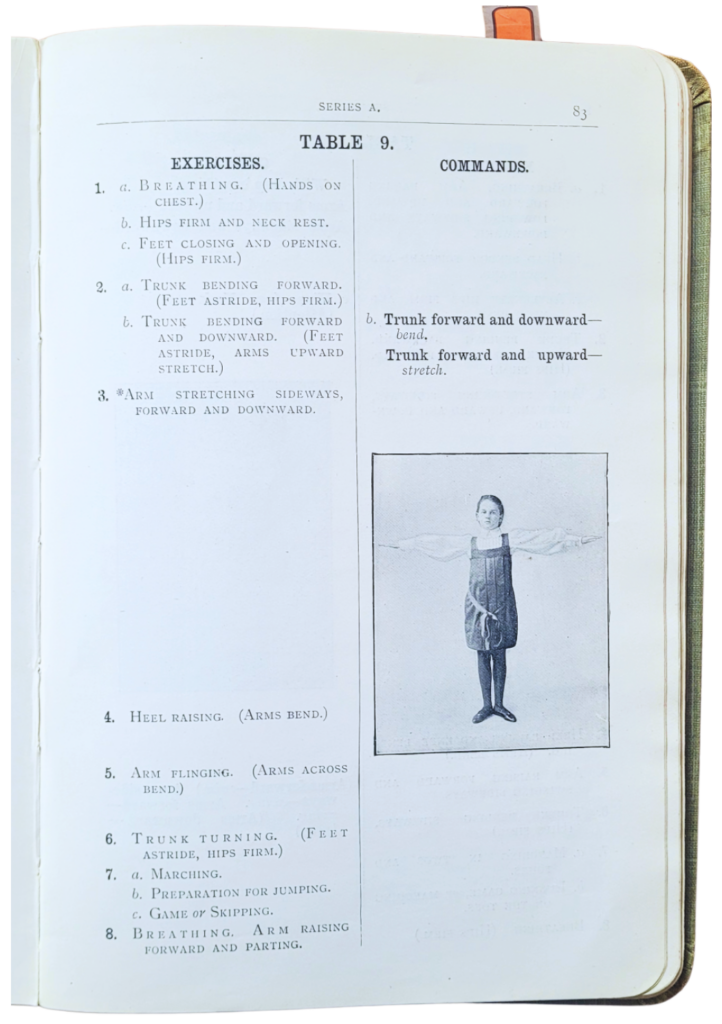
Each table begins with a few introductory movements that are somewhat of a warm-up for the student. Then, the commands address a certain area of the body in a pre-set order each time. For example, the third command is ALWAYS an arm movement. Although the movement itself may change — one table may command arms to simply bend while another may command the arms to stretch forward or sideways — no matter what movement is assigned, at the third point in the table, it will always be an arm movement. And so the pattern continues. In The Syllabus of Physical Exercises for Public Elementary School, 1909, a book used in the PNEU schools, the order of operations for each table was as follows:
- Introductory Exercises
- Trunk Bending Backward and Forward
- Arm Bending and Stretching
- Balance Exercises
- Shoulder Blade Exercises
- Trunk Turning and Bending Sideways
- Marching, Running, Jumping Exercises
- Breathing Exercises[4]
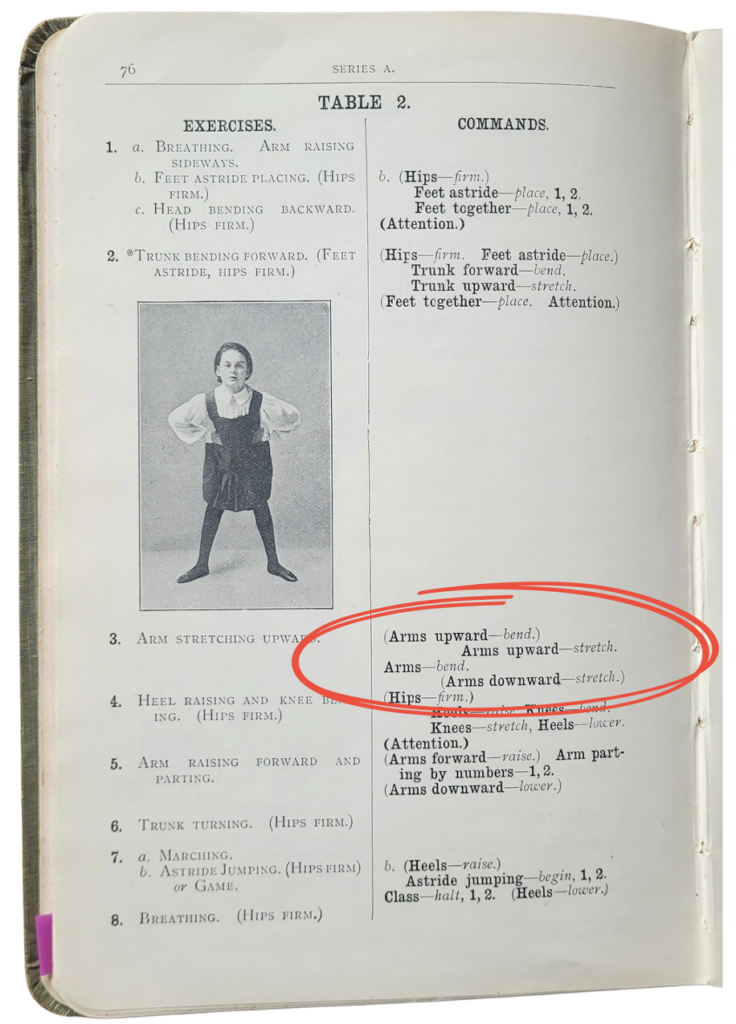
If we continue in our study, we see that in Swedish Drill each table progressively gets more difficult by building on previous skills learned. What begins with a few simple commands of, “Arms upward—bend. Arms upward—stretch.”, as seen in the Table 2 below, slowly progresses over time to a much more difficult command.
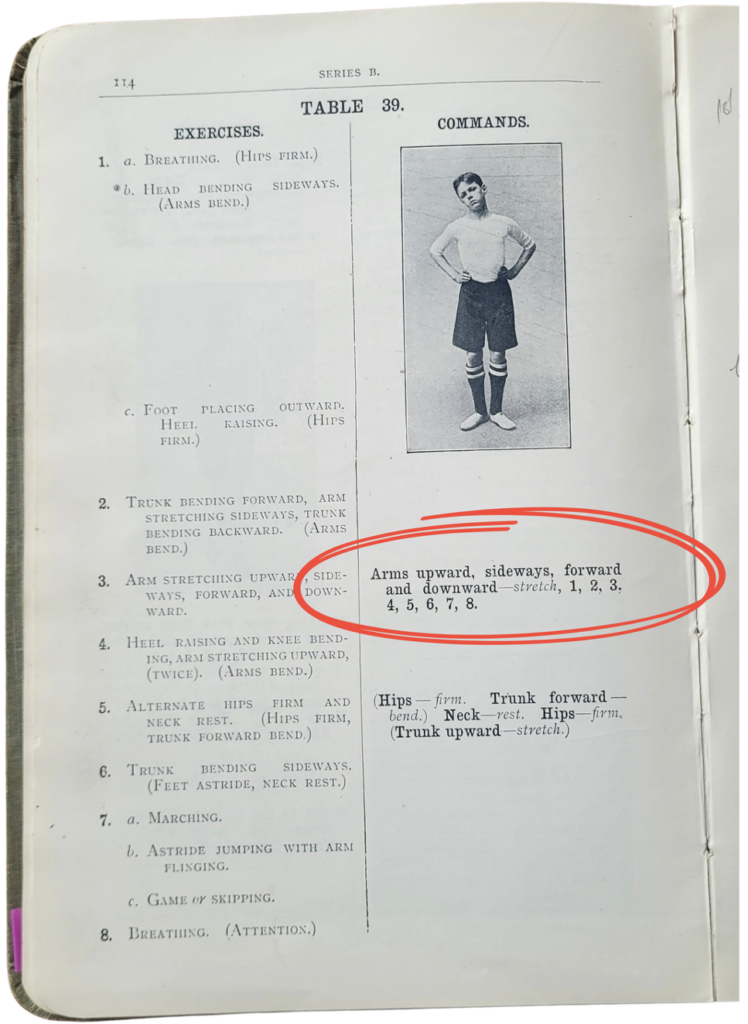
Take a glance now at Table 39, which would have been a few years later for our student. The command has now become much more complicated and requires the student to exhibit much more skill in attention and execution as the teacher states, “Arms upward, sideways, forward and downward—stretch, 1, 2, 3, 4, 5, 6, 7, 8.” The student would be expected to listen to the command, and picture it in their minds as the teacher takes a brief pause to allow them to do so. When the teacher says, “stretch” the student would then execute the arm movements in the order assigned and in rhythm with the teacher’s numbers when stated. It’s incredibly complex and challenging and often performed quickly.
What is happening here is completely consistent with what we see in the rest of Mason’s educational philosophy. Can you ascertain how? In all other subjects, a child is read the lesson or reads it himself and then is expected to share what they learned via narration. Swedish Drill also follows this format and is simply an echo of Mason’s style in the other subjects. Has your science of relations figured it out yet? Wait for it… this may be quite revealing.
Swedish Drill is also a repeating back of what the child has heard, though in physical form; therefore, Swedish Drill is also a form of narration! It is akin to narration by using a child’s body instead of a child’s words. The command is given, a child is given a moment to ponder the command in its entirety, and then they are to display what they have heard as perfectly as possible for the teacher’s eyes. What I’m getting at, my friend, is that Swedish Drill is a kind of physical narration, or narration in motion.
You see, this wasn’t a simple game being played on a teacher’s whim: it was a plan that was executed precisely and was so valuable that the British military itself was also following this method in the training of its troops during this time period.
But the overarching question we must address is, “Is it still relevant for today?”
Intentional physical education has been proven to increase gray matter in the brain, [5] enabling children to focus and maintain attention, a detail that Mason no doubt saw manifested in her study of children, since we see that she had PE every single day in the middle of the morning lessons, no matter the age of the students. [6] But what makes Swedish Drill so unique in her education is the benefits of the practice across a variety of areas. Let’s dive into these for a moment.
Effects on the Brain
The first that stands as a banner worthy of notice are the effects of Swedish Drill on long-term brain pathways. Mason herself was on to something when she spoke of the priority of habits in formation of beneficial ways of life for a child, but modern science has given this idea even more credit by the affirmation that with repeated commands the brain can indeed form physical pathways that can change the lifestyle, thoughts, and habits of an individual. [7] The drill in question also provides this pathway formation as we are asking the student to form brain pathways via movement, connecting the brain and body together. Once a pathway has been formed for “Arms Stretching Upward” and “Feet Astride”, it becomes incredibly simple for the student to connect the two pathways and execute these motions flawlessly together. You will see this evidenced over a long period of time with the children, as they become able to execute lengthy commands over the years with seemingly little thought. Drill not only is creating more pathways throughout the brain, but it’s also stretching those pathways little by little, enabling our children to carry out more and more tasks as the years go by.
Isn’t it ironic how brain pathways, though generated by physical exercise, filter down into other areas of life? Our Father in heaven is such a gracious genius in His creation of such a blessing. As a child extends a brain path by connecting drill movements asked of them such as “Left arm upward, right arm sideways—stretch”, they also extend those pathways in areas relating to the home and schoolroom such as “Can you please put up the dishes, sweep the floor, and take out the trash?” or, “When you’re finished with your math problems, please move on to American history while I help your sister with reading.” The benefits of drill on the brain trickle down into many areas of a child’s life, and subsequently, the parent’s as well.
Effects on the Body
Another benefit of this particular drill is the intimacy a student begins to have with their own muscles and appendages in relation to the world around them, or as we often in the modern age say, their “spacial awareness” or “body awareness”. As a student continues over time with drill, we see that they actually have to consider their own bodies and how they interact with their environment. “Which leg was I just asked to raise?” “Am I to move forward or upward with my arms?” “Are we jumping once or twice in rhythm with the command?” “I just hit the table with my arm, maybe I need more room.” As the students ponder these concepts, they begin to realize which muscles are involved in movements, how these movements affect the world around them, and how to better navigate the world in conjunction with what they’ve been asked to do. This can act as a precursor, of sorts, to anatomy and urge children to continue to care for their bodies as they realize the gift that this machine we live within really is.
As a mother, I’ve also found this a wonderful way to incorporate a kind of therapy aid for the specific needs of my children. Standing at attention often aids in posture problems and commands such as “Arms Stretching Backward” forces the student to roll the shoulders backward in a way that they may not naturally be challenged to do in a world where one often finds themselves hunched forward. Creative teachers may physically aid the formation of their children simply by incorporating simple drill commands that address the issue at hand. I, personally, have worked this into our own routine and seen beautiful results!
Effects on Attention
When I asked my teen daughter, “How do you feel that Swedish Drill has helped you the most?” This is the detail that she boldly landed on as her answer. One of the benefits of drill that separates it from other physical activities is also its requirement for the student to give great attention to detail. A command of “Arms Raise” is quite different from the “Arms Stretch” command, and a student must give their full attention for the entire lesson time in order to correctly display what is being asked of them. Eventually over the years a student may be asked to complete five or six commands in a specific order in rhythm! But to successfully execute this long sequence, the child must start by giving their full attention years before when the movements are simple. So, although drill may seem rather simple in the beginning, it follows the pattern of Mason’s pedagogy of beginning with simple skills that eventually accumulate over a period of time towards something marvelously complex. Isn’t this just like our beloved Miss Charlotte, who presents a consistent pedagogy across the forms and across the feast?
So we can easily see that a crafted exercise program for children matters. Our children need more than simply going outside to play occasionally and Swedish Drill aids our children not only to “get the wiggles out” but to challenge their brain and bodies while simultaneously preparing them for the lessons to come. Do you have a child or teen that seems to be irritable and unfocused by the end of the morning lesson time? Are their attitudes less than pleasant and you’re just hoping to make it to lunch as fast as possible? I’ve been there, and I would challenge you to consider adding drill and exercise as a regular part of your morning lessons. For our family, this simple change has been a game-changer.
So can Swedish Drill be completed with just a few people? Absolutely. Although everything may be more fun in a group, this activity thrives no matter the environment. As a matter of fact, I, personally have always only had two students in my PE class: my son and daughter. For years, we’ve simply gotten into the habit of lining up for drill, and completing our table in about five to ten minutes, leaving the rest of the time to play games, march a little, or work on skills like jump rope. Sometimes we talk during drill and make interesting comments to one another; often, when it feels heavy in the room, one of us will crack a joke to lighten the mood. When they were little, I often would challenge them to make a face like a certain animal while they completed the lesson; after all, as long as they were still able to execute the movements well, why not have fun with it? Although the military may have used this drill, it doesn’t mean we have to BE the military. Another way we do this at home is that we’ll often trade out being the teacher: my child will read the table, and my remaining student and I will do our best to complete the tasks. I highly recommend this, as it allows the teacher to see just how difficult these commands can be and allows us to stand in wonder at the creations of complexity that these small people really are.
Trading the reader of the table is also an incredibly helpful tool for those executing drill with just one student. In such cases, I recommend viewing this as a beneficial exercise to do together instead of necessarily a lesson for the student. Take turns reading the commands. Take the time to watch each other and correct positioning and execution particulars. Have the children create new drill tables for you to try. When executing drill, it is critical that we fight the monotony that can often come with a precise exercise in such a small group. I believe the best way to do this is with variation and adaptation that brings mutual joy to all the individuals present, while still accomplishing our objectives of completion and growing perfection in our execution. So correct the mistakes with joy and laughter, add the elements that are challenging and new, and jump in yourself so that students see how important and fun this aspect of education can really be. Some of our best times doing Swedish Drill together have been when I, myself, have made a blunder of it all.
Getting Started
It has been brought to my attention time and again that getting started with this portion of Mason’s feast can be incredibly intimidating. I, myself, remember the seesaw of weighing the need to add this into our school with the dread of learning it all myself. It seemed such a huge mountain to climb with learning all the commands, how to execute them, and in what order they should be performed in. But, thankfully, as in all of Mason’s subjects, one simply starts at the beginning. No matter the age of your student, whether a young Thought of God in elementary school or a more advanced teen of high school, the playing field is level in Swedish Drill because everyone starts at the beginning in Table 1. Since drill is cumulative, a student must start here, no matter their age.
One way to begin is for the teacher to simply access one of the books Miss Mason used in her schools, like The Syllabus of Physical Exercises for Public Elementary Schools, 1909, via archive.org and jump in and start for themselves. This is the most cost-effective solution, as it’s totally free. This method would require some work, as the Teacher would need to either memorize the commands for each movement as the tables progress or write them out for each Table for reference. He or she would also need to learn the execution of each movement as time goes on and create some lessons gently transitioning from one table to the next. In short, the Teacher can accomplish Swedish Drill with some study and the elbow grease of writing his or her own lessons, if they’re willing to put in the work.
However, if you’re a person who is looking for a faster solution to starting Swedish Drill, there are a few drill resources already created for you, one of which I, myself can boast as author and creator. The variety of resources available out there includes some with photos for direction, others with beautiful graphics that spell out the movements, and even options that include videos of the motions assigned, like my own. Feel free to choose one that suits your family, but if your goal is to have the structure of drill that Mason’s schools seem to have, be sure that the chosen resource has the elements discussed in this article: such as progressing tables, precise execution instructions, and a specific order of movements assigned. There are some really beautiful options out there with all these specifics included that will help you get started with relative ease.
Simply give yourself a small slot each day, or whatever days you can afford to spare, and jump into drill. For us, this is usually about ten minutes for the table portion, with another ten minutes for some kind of activity. But we’ve also moved our activity times to later in the day and simply did drill in a ten-minute slot alone, when our pace of life needed it. I would say that the most important idea is to begin, even if you don’t have all the particulars worked out. As time progresses, you can make changes where needed; but if one never starts an activity, one can never advance in it. Don’t be afraid to make a tentative plan and adapt as you go.
My students are in high school now, and we continue on with Swedish Drill. As a matter of fact, I actually feel that it’s more fun now than it was when they were little. The tasks are more challenging, and we often fail at them, needing to try again as we all laugh it all off. The child that once struggled to tighten their muscles for a straight stretch, now understands what’s being required of them and executes more swiftly and surely. The child that was insecure and watched their sibling for help, confidently performs each command — and where once my kids started flagging at the end of morning lessons, they both are able to give full attention for the full (now) four-hour time slot.
If you saw our family outside doing drill, you wouldn’t see perfection. We still mess it up and dissolve into laughter weekly. However, when they pull off an intricate command in perfect synchronization, the smiles of success and contentment on their faces is enough to convince even the greatest skeptic that Swedish Drill is indeed, still relevant and necessary today.
So if Swedish drill seems daunting to you, fear not, my friend. This beautiful aspect of the feast may be the game changer that you’ve been holding out for, or, to complete our previous analogy, it may be the treasure awaiting you behind the dragon. Will you have the courage and strength to seek it out?
Deep in the woods of west Tennessee, you’ll find a woman whose goal in life is to perfect the elderly skills of front-porch-sitting, tea-drinking, and talking to her heavenly Father. Her love of playing games with children led her to a career in physical education, and her love of devouring books, wandering in the woods, and obsessing over the avian world led her to a lovely introduction with Charlotte Mason twelve years ago. She now fills her days with a variety of adventures such as laughing at her husband and two teens, attempting ridiculous feats in the forest with her scouting club students, or simply traveling the world and through time itself in a good book. Melissa Petermann, our woman in question, has also created numerous physical education and scouting resources in order to aid other educators like herself, since her creative brain will not sit in silence long. You can find her and her resources at this link, or by simply searching for Charlotte Mason PE on your favorite social media outlet.
Endnotes
[1] Chesterton, G.K., Tremendous Trifles, “The Red Angel”, 1909.
[2] Heidi Buschbach, “Musical Drill Practices”.
[3] Charlotte Mason, Home Education, p. 315.
[4] Great Britain, The Syllabus of Physical Exercises for Public Elementary Schools (Eyre and Spottiswoods, Ltd., 1909), pp. 28-58.
[5] Laura Mandolesi, “Effects of Physical Exercise on Cognitive Functioning and Wellbeing: Biological and Psychological Benefits”, National Library of Medicine, 27 April 2018.
[6] Heidi Buschbach, “Musical Drill Practices”.
[7] See James Clear, Atomic Habits: An Easy & Proven Way to Build Good Habits & Break Bad Ones (New York: Avery, 2018).
©2026 Melissa Petermann
Subscribe: Apple Podcasts | Spotify | Amazon Music