The Nativity
[The Saviour of the World] [Volume I] [Book I]
[Poem XI] Poem XII [Poem XIII]
Birth of Jesus.
(The Gospel History, Section 9)
Now it came to pass in those days, there went out a decree from Cæsar Augustus, that all the world should be enrolled. This was the first enrolment made when Quirinius was governor of Syria. And all went to enrol themselves, every one to his own city. And Joseph also went up from Galilee, out of the city of Nazareth, into Judæa, to the city of David, which is called Bethlehem, because he was of the house and family of David; to enroll himself with Mary, who was betrothed to him, being great with child. And it came to pass, while they were there, the days were fulfilled that she should be delivered. And she brought forth her firstborn son; and she wrapped him in swaddling clothes, and laid him in a manger, because there was no room for them in the inn.
The Nativity
(The Saviour of the World, Vol I Book I Poem XII)
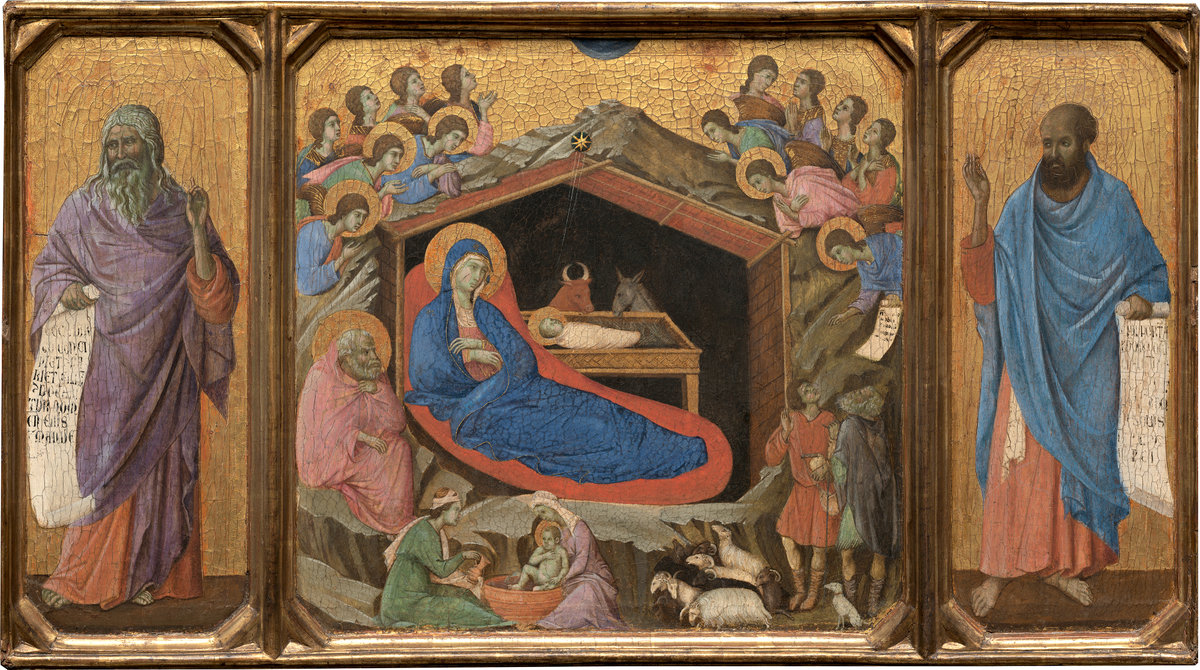
It came to pass, there went out a decree
From Cæsar Augustus to enrol the world:
Each one to his own place, the people went.
And Joseph, too, went out of Nazareth,
City of Galilee, to Bethlehem,
King David’s city in Judæa, for he
Of David’s lineage was; and took with him
Mary, his espousèd wife, being great with child
For her, they journeyed slow; and when they reached
Bethlehem, behold, the Khan was full of folk
Who all had come to register their names;
And groups sate here and there, and talked and ate.
Now, Mary’s hour was come, and she was full
Of anguish, with no place to house her in;
So Joseph, anxious, brought her to the byre
Wherein the travellers’ beasts were housed, and there
Found room for her: and, lo, the beasts were still
Nor gave annoy, what time he, careful, made
What poor provision for his wife he might:
Cold was the night and still, when, thus alone,
The mother bare the Son; and none did see
The brightness of His Rising, save the two.
In swathing bands, she in a manger laid,
For shelter from the cold, the princely Child:
Nor knew that there she laid the Bread of Life
Where ass and oxen for their fodder came.
Not, from His infant birth, the Son of Man
Had where to lay His head in this His world,
But shared the common place the cattle used.
Bless’d Virgin, who didst bear the World’s Delight!
Bless’d Joseph, who first saw the wondrous sight!
Good byre, which sheltered Him from rude affright!
Kind cattle, graced above all beasts that night!
“I was an outcast from my mother’s womb.”
“While yet I hanged upon my mother’s breasts,
Thou wast my hope.”
“There was no room for them in the inn.”
St. Luke ii. 1-8.
“I was an outcast”—Ps. xxii. 9, 10.
Subscribe: Apple Podcasts | Spotify | Amazon Music | RSS
Commentary by J. R. Dummelow
Lk 2:1–5. The census of Quirinius. There are two historical difficulties in connexion with St. Luke’s mention of the census of Quirinius: (1) There is no direct evidence, except St. Luke’s statement, that Augustus (31 b.c.–14 a.d.) ever held a census of the whole Roman empire. (2) Quirinius was not governor of Syria at the time of our Lord’s birth (about 7 or 6 b.c.), but either Sentius Saturninus (9–6 b.c.), or Quinctilius Varus (6–4 b.c.).
As to (1), the absence of direct confirmatory evidence ought not to be sufficient to discredit a statement which is made as a result of careful enquiry, by a nearly contemporary author who is honestly striving to be accurate (Lk 1:3, 4), and which is in itself credible, and in accordance with Augustus’s character and methods of administration. In 8 b.c. he carried out a census of Roman citizens throughout the empire, and it is quite possible that he also planned a general census, which, however, owing to administrative difficulties, was not completely executed in every part of the empire. (2) Although Quirinius was not governor of Syria in 7, 6 b.c., he may have been there as ‘legatus Cæsaris’ to conduct the census, or more probably to carry on the war with the troublesome tribe of the Homonadenses. It was not unusual, when a province was in a disturbed state, for the civil and military administration to be placed in different hands. It is probable, therefore, that, when our Lord was born, Saturninus or Varus was at the head of the civil, and Quirinius of the military, administration of Syria. Quirinius was civil governor of Syria some twelve years later (6 a.d.), when he carried out the well-known census of Ac 5:37, mentioned also by Josephus (‘Ant.’ xviii. 1. 1, 2. 1). It is known, however, from an inscription discovered at Tivoli, in 1764, that he held office in Syria at an earlier date, when he subdued the Homonadenses, and for this exploit was honoured by two ‘supplicationes’ (solemn thanksgivings to the gods), and the decorations of a triumphing general. We may conjecture, therefore, that this was in 7, 6 b.c., at the time when, according to St. Luke, the earlier and less-known census took place.
Lk 2:1. Augustus] The first Roman emperor. His actual reign dated from the battle of Actium 31 b.c. to his death in 14 a.d. Enrolled] This enrolment was perhaps simply a census or numbering of the inhabitants. The second enrolment under Quirinius in 7 a.d. was for purposes of taxation, and excited a rebellion (Ac 5:37).
Lk 2:3. Into his own city] It was a fixed principle of Roman government to respect the feelings and even the prejudices of subject peoples, and Herod, being a foreigner whose rule was barely tolerated by patriotic Jews, had every reason not to give offence. He enrolled his pagan subjects, therefore, in the Roman manner, but allowed the Jews the privilege of being enrolled in their place of origin according to their family and tribe.
Lk 2:5. Who was betrothed to him] Yet they were probably married, because it was contrary to Jewish custom for betrothed persons to live together, and Joseph would wish to protect Mary by making her his wife as soon as possible.
Lk 2:6, 7. The Nativity. See on Mt 2:1. There is an inward fitness that He, who for our sake emptied Himself of His glory, should be born in a stable and laid in a manger, but assuredly it would never have occurred to any one, Jew or Christian, to invent such a story, which accordingly may be accepted as authentic history. By the manner of His birth Jesus showed His sympathy with the hard lot of the poor, and His contempt for human splendour. He also gave a foretaste of His future manner of life, when He was despised and rejected of men, and had no place to lay His head.
Lk 2:7. Firstborn] A technical term among the Jews, signifying ‘that which openeth the womb’ (Ex 34:19f.), and not implying the birth of other offspring. That St. Luke uses it in this technical sense is clear from 2:22, 23. No room] It is clear from Mt 2:11 that as soon as the enrolment was over, and the crowds attending it had dispersed, Joseph and Mary obtained a house in Bethlehem, intending to settle there permanently, since it was the most fitting place for the residence of the Messiah.