The Kings from the East
[The Saviour of the World] [Volume I] [Book I]
[Poem XIV] Poem XV [Poem XVI]
Epiphany.
(The Gospel History, Section 12)
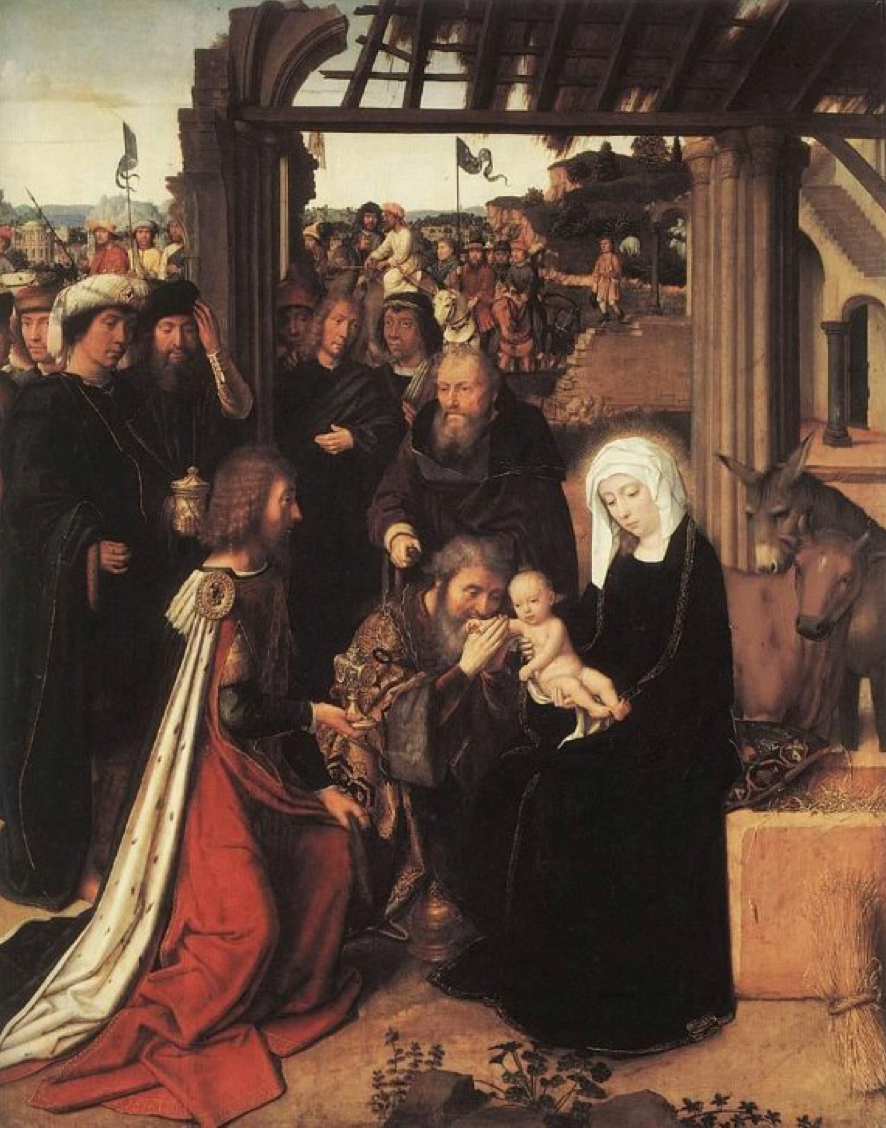
Now when Jesus was born in Bethlehem of Judæa in the days of Herod the king, behold, wise men from the east came to Jerusalem, saying, Where is he that is born King of the Jews? for we saw his star in the east, and are come to worship him. And when Herod the king heard it, he was troubled, and all Jerusalem with him. And gathering together all the chief priests and scribes of the people, he inquired of them where the Christ should be born. And they said unto him, In Bethlehem of Judæa: for thus it is written by the prophet,
And thou Bethlehem, land of Judah,
Art in no wise least among the princes of Judah:
For out of thee shall come forth a governor,
Which shall be shepherd of my people Israel.
Then Herod privily called the wise men, and learned of them carefully what time the star appeared. And he sent them to Bethlehem, and said, Go and search out carefully concerning the young child; and when ye have found him, bring me word, that I also may come and worship him. And they, having heard the king, went their way; and lo, the star, which they saw in the east, went before them, till it came and stood over where the young child was. And when they saw the star, they rejoiced with exceeding great joy. And they came into the house and saw the young child with Mary his mother; and they fell down and worshipped him; and opening their treasures they offered unto him gifts, gold and frankincense and myrrh. And being warned of God in a dream that they should not return to Herod, they departed into their own country another way.
The Kings from the East
(The Saviour of the World, Vol I Book I Poem XV)
Nor came the Desire of Nations all unknown,
Save to the two or three in Bethlehem
And Jerusalem to whose eyes He was shown.
There in the East—where stars are wonderful,
And men, compelled to gaze at midnight skies,
Therefrom draw omens—in the East were those
Who searched the skies for presage of a Good
Which should be unto all men—Christ of God.
And God, who answereth ever in accord
With our poor prayers, sent to those sages learned
The sign they sought: Behold, His star in the East!
They gat them up, and came in Eastern state—
Perchance, three kings, as ancient fable tells,
For should not kings to His bright Rising come?—
Seeking Jerusalem, where King Herod was:
What man so likely as the king to know
Of this new royal Birth: then, “Where is He,”
They ask, “that King of the Jews is born? For we
His star in the East have seen—and come to worship.”
Thus spake they to the king, nor feared at all.
Rumour of this strange quest spread through the streets;
Jerusalem was moved: with holy joy?
Nay; as the king, the people: fear and dismay
Troubled the peace of the easy-living folk.
Herod dissembled with the kings; would show
Him zealous in their eyes; and, gathering scribes
And chief priests of the people, asked of them
Where the Christ should be born: they answered straight:—
In Bethlehem of Judæa, thus spake the prophet:—
“Thou, Bethlehem, in land of Judah, art
In nowise least among the princes there,
For out of thee shall come a Governor,
The Shepherd of My people Israel.”
Sudden, a murderous thought o’ertook the king:
He called the wise men privily, and learned
Of them, with care, what time the star appeared:
“Go,” to the sages said he, “search concerning
The Child, and when ye have found Him bring me word
That I may also worship this new King.”
Simple, they heard the king and went their way;
When, marvellous! the star that was in the East,
Bright, saw they over where the young Child lay:
Whereat exceeding joy filled their good hearts.
Nor were they moved to find in how poor place
The Child and His mother dwelt; obeisance before
The Holy Child made they—touching the ground
With honoured brows, and, carrying His infant hand
To those same brows, swore fealty, as men
Born in the East life-long allegiance vow.
Spreading their treasures open, they offered gifts—
The myrrh of suffering, frankincense of prayer,
And regal gold; for these three men were wise,
And knew how He they worshipped should go forth
To suffer, teach, and pray, to rule—a King.
Well satisfied of heart, elate with hope,
They left, and thought to bring King Herod word:
But that night, as they slept, a counsel came:
“Return not unto Herod.” So they went,
Obedient, to their land another way.
Oh, happy sages come from out the East,
To whom the Christ of God was manifest!
St. Matthew ii. 1-12.
Subscribe: Apple Podcasts | Spotify | Amazon Music | RSS
Commentary by J. R. Dummelow
Mt 2:1–12. The star in the east and the visit of the Magi (peculiar to St. Matthew). The incident fits well into secular history. About the time when the star appeared (7 or 6 b.c.), Herod the Great, being alarmed by a prophecy that the royal power was about to pass away from him and his line, put the authors of it to death. It is evident, therefore, that the announcement by the wise men that Herod’s supplanter in the kingdom had actually been born, would drive him to violent measures. The slaughter of the infants by Herod seems confirmed by the independent account of the heathen historian Macrobius (400 a.d.), who says that when news was brought to Augustus that Herod had ordered children under two years old in Syria to be slain, and that among them was a son of Herod, the emperor remarked, that it was better to be Herod’s pig (hun) than Herod’s son (huion).
That the Magi should be familiar with and sympathise with Jewish expectations about the Messiah, is not a difficulty. Synagogues existed throughout the East, and exercised a wide influence. At Damascus nearly all the women were proselytes (Jos. ‘Wars,’ ii. 20. 2: cp. also 23:15 Ac 2:9 13:43, etc.). Belief that the appearance of the Messiah was imminent—a belief widely cherished in Jewish circles, see Lk 2:25, 26, 38—joined to belief in the appearance of signs in the heavens at the birth of great men, would sufficiently account for the journey of these astrologers, even if they were ignorant of the more definite expectation, which, according to Edersheim, was entertained at this time by the Jews, that two years before the birth of the Messiah His star would appear in the East. The existence of Messianic expectations throughout the East at a somewhat later period is expressly affirmed not only by Josephus, but also by the heathen historians Tacitus and Suetonius. As to the nature of the star, the most probable view is Kepler’s. He calculated that in 7 b.c. there occurred three times a most remarkable conjunction of the planets Jupiter and Saturn in the constellation Pisces, which was next year reinforced by Mars. This triple conjunction was followed by the appearance of a remarkably coloured evanescent star, which was the true star of the Magi. If this view be correct, our Lord’s birth occurred about 6 b.c. (i.e. six years before the vulgar era of the nativity), and the visit of the Magi followed soon afterwards.
The spiritual significance of the story lies on the surface. Whereas Herod and the Jews were ignorant of the birth of the Messiah among them, and, when informed of it, manifested the most malignant hatred against Him, strangers from afar knew of it before then, and hastened to pay Him reverence. The incident is thus a prophecy of the history of the succeeding centuries, in which the chosen people have persistently rejected the Messiah, and the Gentiles have accepted Him. The incident also illustrates the true relations between science and religion. In the persons of the Magi, science paid homage to religion. The Magi were the men of science of the period, and their science brought them to Christ. And so it is now. The science of yesterday was (according to not a few of its exponents) hostile to faith, proudly boasting that it could solve the mystery of the universe. The science of to-day is more humble, acknowledging that the deepest natural knowledge only touches the outer fringe of things, and that so-called scientific ‘explanations’ of the universe are not explanations at all, but only descriptions. Religion and science move on different planes. There is and can be no real antagonism between them, and their natural relationship is one of mutual respect, and cordial coöperation.
Mt 2:1. Bethlehem] or Ephrathah, the city of David, is 5 m. S. of Jerusalem: see Gn 35:16, 19 48:7 1 S 16:4 2 S 2:32 23:14–16 1 Ch 11:16, 26 Ezr 2:21 Neh 7:26. The supposed site of the nativity is a rock-hewn cave, measuring 38 ft. by 11 ft., at one end of which is inscribed ‘Hic de virgine Maria Jesus Christus natus est.’ Above it stands perhaps the oldest Christian church in the world, the basilica built by Helena, mother of Constantine the Great, about 330 a.d. Herod] i.e. Herod the Great, who reigned from 37 to 4 b.c. As Christ was born at least two years before Herod’s death (see 2:16), the date of the nativity cannot be later than 6 b.c. See art. ‘The Dynasty of the Herods.’ Wise men] lit. ‘Magi,’ a sacerdotal class among the Persians, Babylonians, and other Eastern nations, who occupied themselves with a knowledge of the secrets of nature, divination, astrology, and medicine. The Babylonian Magi are mentioned in Jer 39:3. Daniel was made chief of them owing to his skill in interpreting dreams (Dan 2:48). Here the word is used in its strict meaning, and in a good sense. Elsewhere in the NT. it means a juggler or cheat (Ac 13:6, 8). Since astronomy was chiefly practised in Babylonia, and Jewish influence was particularly strong there, it may be conjectured that these Magi were Babylonians. But they may have come from Arabia. There is no warrant for the tradition that they were kings. To Jerusalem] The Magi came because they expected to obtain full information at the capital. 2. In the east] better, ‘at its rising.’ Worship] see on v. 11.
Mt 2:3. And all Jerusalem] They had good reason to be troubled. Only two years before, in a similar fit of jealous fear, Herod had slaughtered all the leading Pharisees (Jos. ‘Antiq.’ 17.2).
Mt 2:4. Herod summons not the Sanhedrin, which he had reduced to a shadow, having slain its members wholesale, but a national assembly of theologians learned in the Law.
Chief priests] The name includes the high priest, the ex-high priests, and members of those families from which the high priest was generally chosen. Scribes] i.e. professional students, copiers, and expounders of the Law of Moses, who rose into prominence after the captivity (Neh 8:1, etc.), and were enrolled as members of the Sanhedrin. Called also ‘lawyers’ (Lk 10:25) and ‘doctors of the law’ (Lk 5:17). The Christ] i.e. the Messiah.
Mt 2:5. In Bethlehem] cp. Jn 7:42.
Mt 2:6. See Mic 5:2. St. Matthew follows neither the Heb. nor the Gk., but gives a free paraphrase. He ‘reproduces the prophetic utterance of Micah, exactly as such quotations were popularly made at that time. Hebrew being a dead language, the Holy Scriptures were always translated (in the synagogue) into the popular dialect (Aramaic) by a Methurgeman, or interpreter, and these interpretations, or Targums, were neither literal versions nor yet paraphrases, but something between them, a sort of interpreting translation. It is needless to remark that the NT. writers would “targum” as Christians’ (Edersheim abridged).
Mt 2:9. The star . . went before them, etc.] a poetical way of saying that the star guided the wise men to Jesus.
Mt 2:11. The house] There is no mention of the stable (Lk 2:7). As soon as the enrolling was at an end, there would be no difficulty in obtaining accommodation. Fell down, and worshipped him] The customary method of doing homage to a monarch. But in their homage was mingled something also of religious worship, because they understood at least this, that the Child before whom they knelt was the Messiah, the religious head of the human race, standing in a unique relation to God, and destined to establish the kingdom of God on earth.
Gifts] It was, and is, the Eastern custom not to approach monarchs and princes without a gift: Gn 43:11 1 S 10:27 1 K 10:2. The Magi brought to Jesus the most costly products of the countries in which they lived, as if to show that nothing is too precious to be used in the service of God. It is a mistake to think that spiritual worship is necessarily a bare worship, or that religion is purest when it is most divorced from art. Art and the love of beauty are among God’s greatest gifts to man, and it is right that man in worshipping should render of his best to God. The mystical interpretation of the gifts (gold, symbolising Christ’s Royalty; frankincense, or incense, His Divinity; myrrh, His Passion, cp. Jn 19:39) is questionable. The Magi would not know that He was actually divine, still less that He would suffer.
Mt 2:12. In a dream] As the Magi were interpreters of dreams, this method of divine revelation was especially appropriate. It is part of God’s loving condescension to mankind to make His revelations to different ages, races, and individuals by those channels through which they are accustomed to expect them.